
History
University Overview
Reinhardt University, founded in 1883, is a private, comprehensive institution grounded in the liberal arts and historically affiliated with the United Methodist Church. Its 620-acre campus is ideally located in Waleska, in the heart of North Georgia’s high country and near the international city of Atlanta.
Reinhardt began as Reinhardt Academy which provided instruction for all ages and grade levels, offering high school degrees. In 1953, it transitioned into an institution of higher education, named Reinhardt College, offering associate degrees to its students. In 1994, the college was accredited by the SACSCOC to offer its first bachelor’s degree program in business administration. In 2010, Reinhardt College became Reinhardt University as it launched its first master’s degree program.
Through its broad approach to positively develop each student’s mind, body, and soul, Reinhardt University nurtures future leaders by providing a holistic educational experience. Engaging students in meaningful classroom experiences, enriching co-curricular opportunities, challenging research projects, community service initiatives, exciting internships, and transformational studies abroad, Reinhardt helps students grow into well-rounded, productive citizens.
Reinhardt offers over 50 graduate and undergraduate programs online and on campus. The University also features 24 intercollegiate sports teams, an array of performing arts and theater programs, and a variety of student groups and organizations.
Names, Places, and Faces: What Makes Reinhardt, Reinhardt
Names of those who have supported Reinhardt University, and believed in its mission, capture the eye unexpectedly throughout campus—a name on a building, plaza, lecture hall, atrium, classroom, or office. Some 70-plus places don the names of people whose deep connection, dedication, and generosity literally built Reinhardt and instilled the pride felt today. Who were these people? Why does Reinhardt honor them?
Watch for new entries on this page, and learn something new about Reinhardt and those whose memory still inspires us.
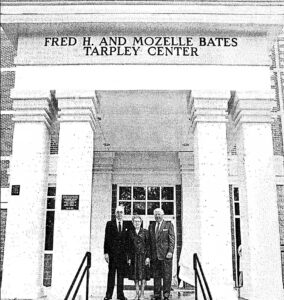
Pictured from left: Fred H. Tarpley, Mozelle Bates Tarpley, and Dudley Moore, Jr. in 2001. Photo courtesy: Cherokee Tribune, by Bill Cranford
Reinhardt University boasts three areas named in honor Dudley Moore and his family: The Moore Family Chapel, Moore Plaza, and the Dudley L. Moore, Jr. Office of Student Activities. Were these named for the English actor, Dudley Moore, who starred in the movie Arthur (1981) and the narrator of The Adventures of Milo and Otis (1989)? They are not, but are named for someone as equally interesting and important.
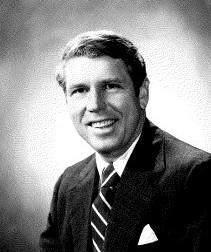
Dudley Moore, Jr. (Reinhardt University Archives)
These areas get their name from a devoted former Board of Trustees member at Reinhardt and an extremely successful Atlanta businessman along with members of his family. The Moore Chapel (located in the Fred H. and Mozelle Bates Tarpley Education Center) honors Guesscelia H. Moore and the memory of Dudley L. Moore, Sr., the stepmother and father of Dudley L. Moore, Jr. The Moore Plaza (located in front of the Tarpley Education Center) honors Moore, Jr. and Moore, Sr. The Office of Student Activities (located in Hasty Student Life Center) honors Moore, Jr. Funds for these spaces were made possible by Moore, Sr., Moore, Jr. and the Peggy B. and Dudley L. Moore, Jr. Family Foundation.
Dudley Lester Moore, Jr. (1936-2024) was born to the late Mildred Lane Moore and Dudley L. Moore, Sr. He graduated from North Fulton High School in 1954 and received a BBA degree in Insurance & Real Estate from the University of Georgia in 1957. In September 1957, he became an employee in his father’s small, independent insurance agency and was named president in June 1971. In December 1965, he married the love of his life, Margaret (Peggy) Bowden.
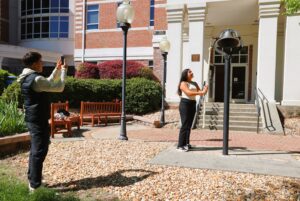
Moore Plaza (Reinhardt University)
Moore, Sr. encouraged Moore, Jr. and through his leadership Moore, Jr. grew a small insurance agency into a multi-state insurance company specializing in underwriting non-standard automobile insurance. In 1986 after several strategic business moves selling and acquiring insurance companies as well as a bank, Moore, Jr. embarked on his largest and most successful endeavor in the insurance industry when he organized Omni Insurance Company, a leading underwriter of non-standard auto insurance. Moore served as chairman and CEO of Omni and oversaw its listing on NASDAQ in 1993 and negotiated its sale to Harford Financial Services in 1998.
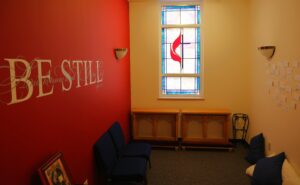
Moore Chapel (Reinhardt University)
He was deeply committed to the insurance industry and served in leadership positions for the National Association of Independent Insurers, Georgia Association of Property & Casualty Insurers, Georgia Surplus Lines Insurers Association and many other industry-affiliated organizations. He is a former “Name,” or underwriting member, of Lloyd’s of London.
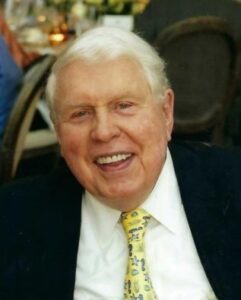
Dudley Lester Moore, Jr. (1936-2024)
Moore served as chairman of the Board of Trustees of Peachtree Road United Methodist Church in Atlanta and a trustee of Royal Poinciana Chapel in Palm Beach. He was a past president of the Cobb Chamber of Commerce. In Palm Beach, he was a trustee of the Society of Four Arts, Preservation Foundation of Palm Beach, a board member of Everglades Club and a long-standing member of the Town of Palm Beach Landmarks Preservation Commission. He loved the outdoors and was passionate about upland bird hunting, wildlife conservation, and land management. He also enjoyed collecting game art, French wines, and international travel.
Choosing the color, pattern, and type of carpeting for your home or business can be a daunting task. What if you had to do it by looking at large rolls in a factory? Thankfully, you don’t have to, because someone in Dalton, Georgia, pioneered the carpet sample device in 1954. This same person, along with his spouse, became highly successful business and civic leaders as well as generous philanthropists. Together, they made a tremendous impact on Reinhardt during their lifetimes and afterwards through their family foundation. Who was that couple?
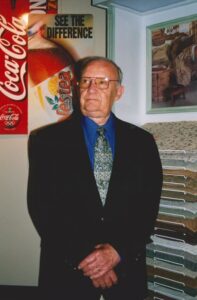
James E. Brown (1927-2004). (Reinhardt University Archives)
They were James E. Brown (1927-2004) and Mary “Sis” Moore Brown (1929-2017). James Brown was born and raised in Dalton, Georgia. He attended Dalton High School, Kings Point Maritime Academy, and the University of Tennessee at Chattanooga. In 1945-46, he served in the United States Merchant Marine Cadet Corps.
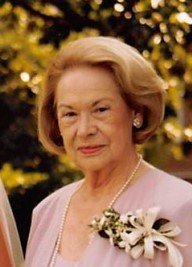
Mary “Sis” Moore Brown (1929-2017). (Reinhardt University Archives)
Mary “Sis” Morris Brown was born and raised in Oneida, Tennessee. As the youngest of seven children and only girl, her nickname “Sis” stuck, and she was known by it her entire life. Having all brothers meant she tagged along with them often, even joining the Boy Scouts when there was no Girl Scout troop. Growing up during the Great Depression instilled the importance of helping others, and throughout her life, she lived by the Golden Rule. During World War II, she served as a telegraph operator and afterwards followed one of her brothers to Dalton, Georgia, where he had a job with a local supply company. The move proved to be fortuitous; in Dalton, she met the love of her life, James Brown, and they were married in 1949.
In addition to the carpet sample industry, James and Sis Brown’s partnership led to the founding of Brown Printing and, later, Brown Industries, Inc., along with four other businesses. James’ success as a businessman led to early accolades as Dalton’s Young Man of the Year (1957) and Man of the Year (1958). He served as director on many boards, including the First National Bank of Dalton, Multivision Northwest WTTI Broadcasters, Athens TV Cable of Alabama, Scottsboro TV Cable of Alabama, and others. James led a life of service to his church, Dalton First United Methodist, his community, and the state of Georgia. The list of institutions he led proves exhaustive—State of Georgia: Georgia World Congress Center Authority, Governor’s Education Review Commission, Dalton State College Foundation, Board of Regents The Georgia University System and Georgian’s for Better Transportation; Dalton: Utility Commission, Creative Arts Guild, Rotary Club, Civitan Club, Board of Education Dalton Public Schools, and Youth Baseball, among others. Accolades for James included citations from the City of Dalton for service, a Humanitarian Award from Whitfield Healthcare Foundation, and induction into the Dalton Education Hall of Fame.
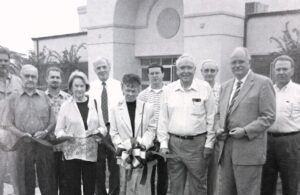
James and Sis Brown (front row, left) cut the ribbon at the James and Sis Brown Athletic Center dedication. (Reinhardt University Archives)
Sis was tirelessly involved with their businesses and the community as well. It was noted in her obituary that she was one of the two original employees still working at Brown Industries. The organizations she served included Hamilton Medical Center (Gray Lady Volunteer Program), Alzheimer’s Auxiliary (founder), Dalton First United Methodist Church, Girl Scouts of Northwest Georgia, Community Foundation of Northwest Georgia, and the Dalton State College Foundation. According to a Dalton Sun Times article in 2021, “In 2005, Sis Brown joined the executive committee of the foundation. She chaired the largest fundraising campaign in its history. The foundation’s goal had been to raise $16 million. Under her leadership, it raised $21 million.” Also noted in the article, David Aft, president of the Community Foundation of Northwest Georgia, stated in 2017 on the passing of Sis Brown. “They cared about this community. They understood it would take everyone doing their part if we were going to reach the future they thought was possible. They were among Dalton’s most outstanding citizens. Their impact on this community is unrivaled.”
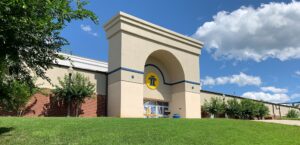
James and Sis Brown Athletic Center. (Reinhardt University)
For Reinhardt, James is best remembered for his long service as a member of the Board of Trustees (1974-2004) and a member of the Executive Committee (1982-2000), where fellow trustees often remarked on his wisdom and common sense, as well as his quiet and humble manner. Together, James and Sis contributed generously to the annual fund, scholarship funds, and athletics. The Athletic Center is named in their honor. They also established a family foundation, led by their daughter, Lynn Whitworth, and grandchildren, Chip Whitworth and Tracee Reynolds, that continues to support Reinhardt University. Reinhardt remains ever grateful for their commitment and vision to support their community and Reinhardt University’s students.
(Reinhardt University )
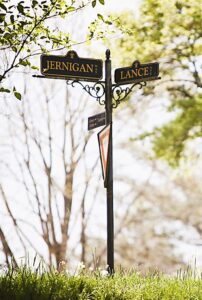
Reinhardt University’s Lawson Academic Center, Tarpley Education Building, Hill Freeman Library, and Dobbs Science Building can all be found along Lance Way, a road named for Thomas Bertram “Bert” Lance (1931-2013) (RU-1981H). Bert Lance served on Reinhardt’s Board of Trustees from 1969-1983 and as Board chair from 1974-1983. His importance and fame extended well beyond Reinhardt’s campus as a major Democratic party leader who supported and advised upon the careers of President Jimmy Carter, Zell Miller, Walter Mondale, and Jesse Jackson, a public servant at the state and federal level, a controversial figure in the banking industry, and as the man who in 1977 popularized the saying “If it ain’t broke, don’t fix it.”
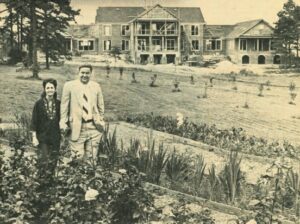
LaBelle and Bert Lance. (Reinhardt University Archives)
Bert Lance was born in Gainesville, Georgia to Annie Rose Erwin Lance (1894-1988) and Dr. Thomas Jackson Lance (1886-1980), the president of Young Harris College from 1930-1942. Bert Lance attended the University of Georgia and Emory University but dropped out before completing his degree to support his family.
He married LaBelle David and soon after began a career in banking at the Calhoun First National Bank with the help of LaBelle’s grandfather. He rose from teller to president by the age of 32. In 1970, he was elected Director of the Georgia State Highway Department. He served as Commission of the Georgia Department of Transportation from 1971-1973 under then Governor Jimmy Carter, and was a candidate for Governor of Georgia in 1974.
In the 1970s, Lance was quoted in a national business magazine saying, “If it ain’t broke, don’t fix it,” which popularized the saying. Former New York Times columnist William Safire, said of Lance, “He will be remembered, first of all, as a lexicographer. He gained immortality with ‘If it ain’t broke, don’t fix it,’” said Safire, who attributed the phrase to Lance in his American Political Dictionary.
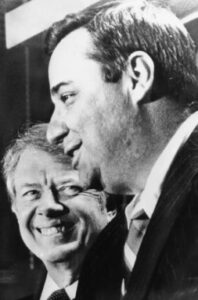
President Jimmy Carter and Bert Lance. (Reinhardt University Archives)
“He was the kingmaker, rather than the king,” said former Georgia Gov. Roy Barnes of Lance. Lance’s support of Jimmy Carter helped Carter to secure the U.S. presidency. As a Carter protégé, confident, and ally, Lance was appointed to Director of the Office of Management and Budget. Lance was known to pray with Carter in mornings at the White House and was sometimes referred to as “deputy president” because of his close relationship with Carter.
However, Lance’s service was cut short in 1977 when he was indited for banking related charges (later acquitted) and resigned. In 1984, Mondale unsuccessfully attempted to install Lance as the chair of the Democratic National Committee due to the media’s focus on his indictments and other charges. In Lance’s memoir, The Truth of the Matter: My Life In and Out of Politics (Summitt Books, 1991), he claimed, on the basis of the 400,000 pages the Justice Department gathered about his banking practices, to be the most investigated person in the nation’s history.
In Bert Lance’s August 15, 2013, obituary written by Jim Galloway of the Atlanta Journal Constitution, it was stated,
“Lance was the consummate insider, whether as a lay leader of the North Georgia Conference of the United Methodist Church or an adviser to international financiers. Dealing with customers at the bank, he said, taught him important things about people, about their financial concerns and their political aspirations. “I’ve had so many failures that it’s unusual to talk about successes,” Lance said later in life. “But I would hope it could be said I had the ability to listen to people and understand what they were talking about.”
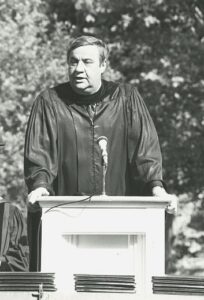
Thomas Bertram “Bert” Lance (1931-2013). (Reinhardt University Archives)
Upon learning of Lance’s death, President Jimmy Carter offered the following statement:
“Bert Lance was one of the most competent and dedicated public servants I have ever known. As head of the Department of Transportation in Georgia, he was acknowledged by all the other cabinet level officials as their natural leader, and he quickly acquired the same status in Washington as our nation’s Director of the Office of Management and Budget.
“Bert was one of the closest personal friends I have ever had and was always a fountain of sound advice about the most detailed issues of our state and nation. His never-failing sense of humor and ability to make thousands of friends were just two of the sterling qualities that made knowing Bert such a valuable part of our lives.
“He and Labelle were a wonderful couple during their 63 years of marriage, and Rosalynn and I extend to her and their family our condolences, with the knowledge that they will be strengthened in this time of sorrow by their memories of wonderful times together.”
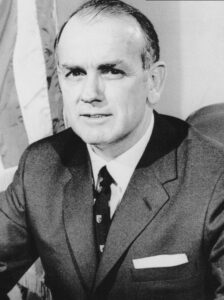
Randolph Thrower (1913-2014). (Reinhardt University Archives)
During a ceremony to name the Herbert I. and Lilla W. Gordy Department of Art on November 14, 2000, Randolph Thrower was honored by former board chairman Lynn H. Johnston, who surprised him by announcing that the plaza on the west side of the Fincher Visual Arts Center would be named in his honor. “This beautiful plaza will henceforth be known as the Randolph W. Thrower Plaza,” Johnston said, “and we honor you with this, Randolph, as a way of saying thank you so much for all you’ve done for the College all these years.”
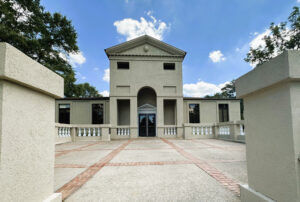
Randolph W. Thrower Plaza at Reinhardt
Thrower was a longtime friend of the Gordy family, executor of their estate, and a member of the Reinhardt board of trustees from 1963 to 1975. He is known in great measure for, among other things, resisting President Richard Nixon when serving as Commissioner of the I.R.S. from 1969 to 1971.
(The following information was compiled from several articles in the Atlanta Constitution Journal and The New York Times.)
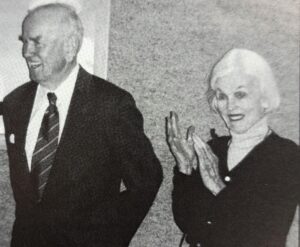
Randolph and Margaret Thrower. (Reinhardt University Archives)
Randolph William Thrower was born September 5, 1913, in Tampa, the youngest of three children of Benjamin Thrower Jr. and Ora Hammond Thrower. His father was working in real estate when he died in 1915. He and his siblings were raised by grandparents in Atlanta. He began to practice law after graduating from Emory’s law school in 1936. He and wife, Margaret Logan Munroe Thrower, had four daughters, Patricia Barmeyer, Margaret MacCary, Laura Harris and Mary Wickham; a son, Randy; 11 grandchildren; and nine great-grandchildren.
Thrower became an FBI agent in the early 1940’s and served in the Marine Corps during WWII before getting into politics, unsuccessfully running for Congress as a Republican in 1956. Continuing his political and legal involvements, he was later appointed as commissioner of the Internal Revenue Service under President Richard M. Nixon.
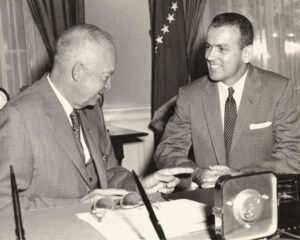
Dwight Eisenhower and Randolph Thrower. (Reinhardt University Archives)
In Thrower’s two years as I.R.S. Chief, he introduced a number of reforms, including a simplified, one-page version of Form 1040, helped draft the Tax Reform Act of 1969, which reduced taxes for people with lower incomes and raised taxes on capital gains, and in 1970, he overturned an IRS ruling that had allowed segregated private schools in the South to claim tax exemptions. His clash with the Nixon Administration over unethical appointments and efforts to ‘punish’ political enemies led to his resignation in 1971.
Thrower’s legal specialty was taxation, but he also handled civil rights appeals throughout his life and was a founding member of the Lawyers’ Committee for Civil Rights Under Law. He was chairman of Atlanta’s Board of Ethics (ABA) throughout the 1980s and held leadership positions with the American Bar Association. In 1987, he was a member of the ABA’s first Commission on the Status of Women in the Profession. In 1993, Mr. Thrower received the ABA’s highest award for contributions to the legal profession. He continued his legal practice until his death on March 8, 2014 at the age of 100.
Paul Vitello wrote Thrower’s obituary, “Randolph Thrower, I.R.S. Chief Who Resisted Nixon, Dies at 100,” in The New York Times on March 18, 2014. The follow excerpt from the obituary tells the story of a man with extraordinary grit and resolve.
“Randolph W. Thrower, a Republican lawyer who headed the Internal Revenue Service under President Richard M. Nixon from 1969 to 1971 before losing his job for resisting White House efforts to punish its enemies through tax audits, died March 8 at his home in Atlanta. He was 100.
“A daughter, Patricia Barmeyer, confirmed the death.
“Mr. Thrower’s unusual legal background — as a federal tax law expert and a lawyer for death row inmates in Georgia, most of them black, in the Jim Crow era — helped garner wide support from lawyers’ groups and lawmakers when Nixon nominated him for I.R.S. commissioner.
“And though his tenure was short, he was instrumental in two historic overhauls of American tax policy: revoking the tax-exempt status of private schools that excluded blacks, and passage of the Tax Reform Act of 1969, which he helped draft. The legislation eliminated some loopholes for the rich and exempted many poor people from federal taxes altogether.
“The end came in January 1971, after Mr. Thrower requested a meeting with the president, hoping to warn him personally about the pressure White House staff members had been placing on the I.R.S. to audit the tax returns of certain individuals. Beginning with antiwar leaders and civil rights figures, the list had grown to include journalists and members of Congress, among them every Democratic senator up for re-election in 1970, Mr. Thrower told investigators years later.
“He was certain the president was unaware of this and would agree that “any suggestion of the introduction of political influence into the I.R.S.” could damage his presidency, he said.
“Mr. Thrower received two responses. The first was a memo from the president’s appointment secretary saying a meeting would not be possible; the second was a phone call from John D. Ehrlichman, the president’s domestic affairs adviser, telling him he was fired.
“He agreed to stay on until a replacement could be found, did not voice his concerns publicly about the administration’s growing appetite for prosecuting its putative enemies, and never disputed the White House explanation for his departure — that he had resigned “for personal reasons.”
“In White House tapes and memos released in later years, Nixon described the situation differently. “May I simply reiterate for the record that I wish Randolph Thrower, commissioner of the Internal Revenue Service, removed at the earliest feasible opportunity,” he wrote on Jan. 21, 1971, five days before the White House announced that Mr. Thrower was stepping down.
“That May, as the administration continued to look for a successor to Mr. Thrower, Nixon made clear what kind of I.R.S. commissioner he wanted. “I want to be sure he is a ruthless son of a bitch,” he was recorded as saying, “that he will do what he is told, that every income tax return I want to see I see” and “that he will go after our enemies and not go after our friends.”
“Mr. Thrower, who had long been involved in Republican politics in Atlanta, had not worked in Nixon’s election campaign in 1968. He met Nixon for the first time, he said, when he was appointed I.R.S. commissioner. Seeing Nixon as a shrewd politician who viewed tax overhaul as a winning issue, he took the job, he said, hoping to bring a progressive approach to federal tax policy. But, he added, he “did not like him from the first.”
…
“Mr. Thrower encountered several White House operatives while he was I.R.S. commissioner who would later play roles in the Watergate scandal. The one who alarmed him the most, he told interviewers, was G. Gordon Liddy, the former F.B.I. agent who helped plan the break-in of the offices of the Democratic National Committee at the Watergate complex in 1972. Mr. Liddy was sent to him in 1970 as the White House candidate to head the Bureau of Alcohol, Tobacco, and Firearms, then a branch of the I.R.S.
“He was a gun nut,” Mr. Thrower said. “They wanted me to put a gun nut in charge of guns.” Mr. Liddy did not get the job.
“But it was not Watergate that haunted Mr. Thrower; it was the case of Will Coxson, a black teenager convicted in the late 1930s of raping a white woman in Marietta, Ga., and sentenced to die. Mr. Thrower took the case on appeal in 1940 and discovered that Mr. Coxson’s alibi was solid and that the victim’s initial description of her attacker as “a light-skinned black man” had changed significantly when the prosecution brought the case to trial. Mr. Coxson was dark-skinned.
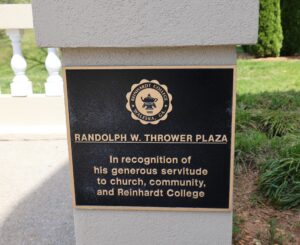
Signage designating Thrower Plaza
“The Georgia Supreme Court ordered a hearing on whether Mr. Coxson had received adequate representation, and Mr. Thrower was preparing for that when he left to join the Marines. Turning the case over to another lawyer, he said, he felt sure that the evidence would sustain an appeal all the way to the United States Supreme Court if necessary and win Mr. Coxson’s freedom. But the case “withered on the vine,” he said, and while Mr. Thrower was serving in the Pacific, Mr. Coxson was executed.
“For the past 60 years, no case has kept me awake at night as much as this,” he said in a 2001 lecture, “wondering what else I might have done to save the life of this young man. His life should not have been taken.”
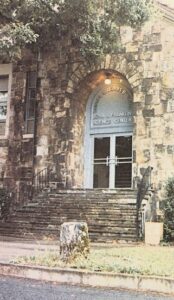
The John L. Franklin Science Center entrance in 1977. (Reinhardt University Archives)
Before cellphones, the most reliable way to learn the correct time of day and temperature was to use a landline to call a local phone number. When answered, a voice would say, “The time is now…” and tell you the time, and often the temperature. The device and technology that made this possible (and popular) were developed by John L. Franklin (1887-1961) and the Audichron Company. Franklin’s impact has been known to generations, but many may not know that Franklin’s success gave way to Reinhardt’s John L. Franklin Science Center (dedicated October 28, 1964) and numerous scholarships via the John and Mary Franklin Foundation (established 1955).
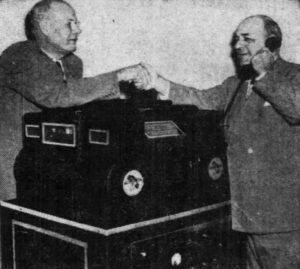
Pictured from left: John Franklin and Erle Cocke, President of the Fulton National Bank, in 1944. (Reinhardt University Archives)
According to an Atlanta Constitution article by Joe Brown in 1976, “[The idea for the Audichron Company] began in 1934, when an Atlanta entrepreneur named John L. Franklin took some motion picture film and—ignoring the picture frames— recorded himself announcing the time, minute by minute, on the soundtrack. Franklin’s fascination with the time was not new. He had used it in a more traditional form to promote one of his earlier enterprises: Tick Tock Ginger Ale. Tick Tock— brewed and distributed to Georgia in the 1920s— was known for its Tick Tock billboards, each of which featured a built-in working clock, commonly known as the Tick Tock clock.”
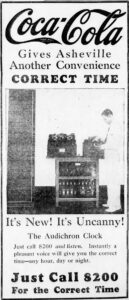
Image courtesy: Asheville Citizen-Times, October 2, 1938.
Franklin perfected his magnetic recording tape method by stripping off the narrow soundtrack and spiraling it around a chromium drum with a motor-driven pick-up head and then wiring it to a speaker. He rented the machines to local merchants, installed them on site, and connected them to local phone lines. Coca-Cola became one of his first and best customers.
By 1949, the Atlanta Constitution reported the service was used nationwide, fed by 35 different phone lines, which answered 42,000 local telephone calls a day. In 1945, only 45 percent of households had telephones. The president of Fulton County Bank, Erle Cocke, said, “Audichron is an invaluable aid in helping Atlantans to get to work and to keep appointments on time.” Later, the machines also provided weather updates, and other messages such as “The number you have dialed is not in service.” In 1976, the Audichron Company, located in Chamblee, Georgia, became the world’s largest producer of these machines.
The original voices for the Audichron include two women from Georgia, Mary Moore (time) of Atlanta and Tedi Thurman (temperature) of Midville. In 1959, Moore explained how it worked—four cylinders separately recorded, “the time is now,” hour, minute, and second. She also noted that Franklin hired her himself, “Franklin was looking for a local voice at the time, and I was doing a radio show. He heard about me. I tried out and have been the voice ever since.” To see and hear the Audichron, click here: The Audichron STM, history and how it works.
John and his wife, Mary Owen Franklin (1890-1973), dedicated their lives to the service of humanity through various philanthropies, including Reinhardt University. They founded the John and Mary Franklin Foundation in 1955. Mary Franklin, a graduate of Brenau College (Gainesville, Georgia), led the Foundation after John’s death. The Franklins and the Franklin Foundation have supported Reinhardt since 1958.
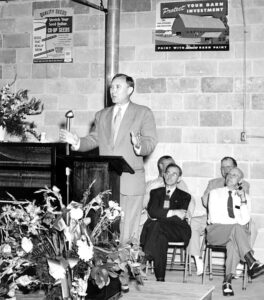
David William (D.W.) Brooks. Photo Courtesy: Richard B. Russell Library for Political Research and Studies, University of Georgia Libraries.
According to Reinhardt’s records, the connection to Reinhardt began via the late David William (D.W.) Brooks (1901-1999), a Reinhardt member of the Board of Trustees (1954-1999). Brooks once conveyed that John Franklin originally served as a Methodist minister but left the church to become an entrepreneur. Franklin later wished to support a Methodist institution and chose Reinhardt upon the advice of Brooks.
Brooks was known for his work helping farmers by starting an agricultural cooperative in the early 1920s, which after several iterations, became known as Gold Kist. Brooks served as an advisor on agriculture, economics, and trade to seven U.S. presidents. Franklin would have also likely known about Reinhardt through his business dealings with Coca-Cola’s executives Samuel Dobbs and George Lawson, who were also Reinhardt trustees during the early and mid-20th Century.
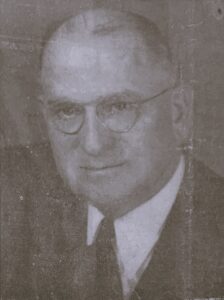
Paul W. Jones. (Reinhardt University Archives)
Just months before Paul Walker Jones of Canton, Georgia, passed away he wrote, “I, Paul W. Jones, of Cherokee County, Georgia, believing implicitly in a Triune God, and trusting sole and simply in my Lord and Savior Jesus Christ, and in Him alone, who has made it possible for me to accumulate some little of this world’s goods, desire, in humble recognition of the blessing given me, to return some of it, in a way, to a work for the benefit of the people among whom I was born and have lived, feeling that the Kingdom will be thereby furthered.”
These words served as the preamble to the establishment of the Paul Jones Fund in 1941, which provided monies to organizations in Cherokee County, including Reinhardt University, ever since. The Jones Fund is just one way Paul Jones left a legacy at Reinhardt. The University extends its gratitude to Paul Jones and his descendants for nearly 100 years of support.
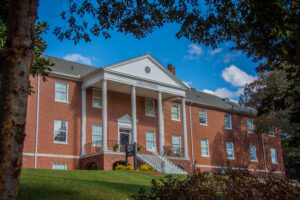
Paul W. Jones Hall
Paul Jones served as a member of Reinhardt’s Board of Trustees. In that capacity, he led the efforts to raise funds and build one of Reinhardt’s iconic structures on the corner of Routes 108 and 140, which was named in his honor. Built in 1939, Paul W. Jones Hall originally served as a women’s dormitory. Today, Jones Hall houses the University’s Price School of Education.
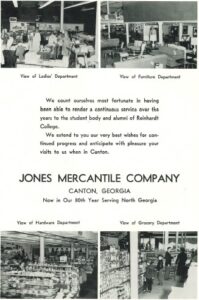
A post which was published in Reinhardt’s 1958 yearbook.
Paul Walker Jones (1881-1941) was the son of successful businessman Colonel Robert Tyre “R.T.” Jones, Sr. (1849-1937) and Susie Smith Walker Jones (1856-1899). R.T. Jones established Canton Cotton Mills* (known for its fine denim) and Jones Mercantile (the precursor to large department stores). Canton’s R.T. Jones Memorial Library is named in R.T. Jones’ honor.
Paul Jones left school at the age of 13 to work for his father and rose to the company’s presidency. He was known as a prominent businessman and leader in North Georgia’s civic, banking, business, and agricultural circles. He was active in livestock improvement and introduced purebred Hereford cattle to the area. He also established a creamery and ice cream plant to provide an outlet for local farm products.
Jones married Mary Foute (1884-1958) of Cartersville, Georgia, and they had five children: Foute, Tom, Paul, Jr., Susan, and Mary. His nephew, celebrated golfer Bobby Jones (1902-1971), established the Augusta National Golf Club (1933) and the Masters Golf Tournament (1934).
*The Canton Mills closed in 1981. Today, the location of mill #1 is known as The Mill on Etowah and features retail and dining venues, and the location of mill #2 is known as the Canton Mills Loft Apartments.
In 1924, two bright-eyed students full of love, promise, and ambition attended graduation at Reinhardt Academy. These students, Evelyn “Mimi” Jackson and Frank Gordy were about to embark on a life’s journey of success and impact now keenly felt today at Reinhardt and throughout Georgia. Little did they know, just over a century later, Reinhardt would be celebrating their daughter, Nancy, and holding her in the institution’s highest esteem.

From left: Bishop Joel McDavid, President Allen O. Jernigan, Evelyn Gordy Rankin, and Norman Paschall, chairman of the board of trustees, at the groundbreaking for the Gordy Dining Center. (Reinhardt University Archives)
In 1928, Frank Gordy started The Varsity in Atlanta, which was a success from the very beginning. He married Evelyn in 1930. They continued to expand the restaurant, and its hot dogs, burgers, fries, onion rings, and fried pies became legendary. Frank was known for his work ethic, high standards, innovation, and generosity. Evelyn was known for her character, reserved graciousness, insistence on excellence, and keen eye for beauty and all things aesthetic. Frank and Evelyn held dear their love of Reinhardt. Their contributions to the institution, numbering in the millions, have left an indelible sense of campus pride. The Frank and Evelyn Gordy Dining Center and the Evelyn Gordy Hospitality House are just two examples. Evelyn also served with distinction on Reinhardt’s Board of Trustees from 1980 until her death in 2004.
Some say, “the apple doesn’t fall far from the tree” when describing a child of such high-achieving parents, but in the case of Evelyn and Frank’s daughter Nancy Gordy Simms, perhaps it is more apt to say that “the apple pie doesn’t fall far from The Varsity.” Nancy never expected to follow in her father’s footsteps, but after the death of her father and other unforeseen circumstances, she stepped up to lead the family business in 1983, where she served as president and chairman of the board, leading it to even greater success before handing the reigns over to her son, Gordon Muir.

Evelyn Gordy Rankin in front of the Evelyn Gordy Hospitality House on Reinhardt’s campus. (Reinhardt University Archives)
What could be said of her parents goes double for Nancy. She is the perfect combination of both her parents—as smart, wise, gracious, beautiful, and iron-willed as her mother and as hardworking, visionary, high achieving as her father while sharing both parents’ profound sense of magnanimity and dedication to Reinhardt. Since 1985, Nancy has often shared her business savvy and commitment to greatness as a member of the Board of Trustees. Her 40 years of consecutive giving has made possible many initiatives and scholarships. The private dining rooms in the Gordy Dining Center and the garden behind the Dining Center are named for Nancy. An endowed scholarship is named for her late son. Reinhardt is truly grateful for her service and generosity.
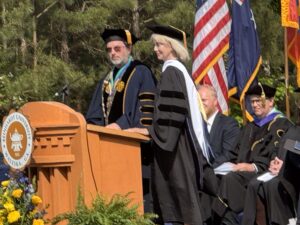
Reinhardt President Dr. Mark Roberts with Nancy Gordy Simms (RU-2025).
In addition to serving Reinhardt, she has served or currently serves as a board member for the Metropolitan Atlanta Council of Alcohol & Drugs, Egleston Scottish Rite Foundation, The Buckhead Girls Club, Emory University Center for Ethics in Public Policy and the Professions, Emory University, Feed My Lambs, Inc., and Rotary Club of Atlanta. She been honored by the Atlanta Convention and Visitors Bureau as a member of the Hall of Fame, by the Buckhead Girls Club as their Woman of the Year in 2010, and by Day One Ministry with their Day One Faith Award for her commitment to her church and community. Nancy Simms attended University of Georgia and is an active member of her church— Peachtree Road United Methodist Church. She has three children, nine grandchildren, and six great-grandchildren.
At the University’s 2025 commencement, another accolade was added to Nancy’s list of awards. She was presented with an Honorary Doctorate of Humane Letters from Reinhardt University for her contributions to Georgia as a businesswoman, entrepreneur, civic leader, and philanthropist as well as for her love, devotion, and care for Reinhardt’s students, faculty, and staff. Her contributions to ensure a more functional and beautiful campus along with her support of scholarships and faculty excellence endear her to us all.
Metaphors about generous donors and leaders abound in higher education. When someone makes generous contributions to establish a program or a scholarship, the gift’s framing includes phrases such as “foundational to growth,” “a pathway to success,” or “building excellence.” At Reinhardt, one man’s contribution wasn’t just a metaphor for the transformation of an institution; it was literally a building material that made a monumental difference – concrete.
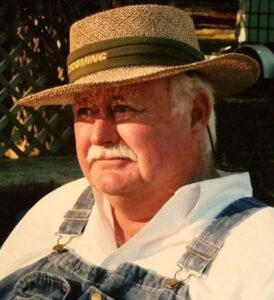
Randall Odith Porter. (Reinhardt University Archives)
For decades, Randall Odith Porter (1942-2020), originally of Canton, Georgia, generously supported the construction of numerous capital projects through contributions from the company he co-founded, Fulton Concrete Company of Alpharetta, Georgia. Why would Porter do all that for Reinhardt?
Porter wasn’t a Reinhardt alum. His involvement began in 1986 at the behest of his mentor and Reinhardt board of trustees member, Norman Paschall. Porter started working at the Norman W. Paschall Company at the age of 20 in 1962 and had worked his way up from sales, superintendent, and supervisor to a warehouse foreman in 1971. It was Porter’s first job. Of Paschall, Porter stated, “He taught me a lot.”
Porter then worked at Jackson’s Atlanta Ready Mix Concrete Company in Atlanta until 1973, when he decided to co-found the Fulton Concrete Company. By 1986, he was a full owner, and the company had $21 million in sales and 125 employees with plants in Fulton, Cobb, Gwinnett, and Hall counties.
As a member of Reinhardt’s board of trustees, Porter became immersed in the work of the buildings and grounds committee and, after just a year, became chair of the committee. In a 1989 article, Porter remarked, “I took the position out of obligation to him [Paschall] for raising me, but I have stayed because I enjoy it so much.” Porter generously supported Reinhardt in many ways. The largest contributions came through Fulton Concrete, which provided the foundation and sidewalks around several buildings such as the George Lawson Academic Center, Hagan Chapel, and Falany Performing Arts Center, among others.

The Randall O. Porter Building
The Randall O. Porter Building, used by the building and grounds department, whose foundation was provided by Porter’s company, is another example of his generosity. It was dedicated on May 17, 1989, with words by Norman Paschall in his capacity as board chairman. About the importance of the building’s purpose to store equipment, surplus materials, and other items, Porter explained the need for the 600-plus acre campus, “Woods have to be managed as well as the buildings. Mature trees have to be removed, and upkeep is necessary.”
When Porter passed away in 2020, he was remembered fondly:
“Randall was a giving man who loved his family and friends dearly. His more recent joys were the simple pleasures of grandchildren’s smiles and relaxing days on the farm. He had a larger-than-life personality, always enjoyed a good laugh, and had a smile that lit up the room. He was an avid warbird aviator and could often be found with his fellow ‘Georgia Boys’ flying in airshows across the country. Randall and friends established the Air Acres Museum to restore and fly vintage military aircraft, making these great warbirds available to the public, and he was a founding member of EAA Warbird Squadron 17…
He was active in his community for many years, through service as a member of the Reinhardt University Board of Trustees, Chairman of the Board for First Colony Bank, North Fulton Regional Hospital Board of Directors, North Fulton Rotary Club, Fayette County Masonic Lodge 711, and a life member of the Yaarab Shine.”
In addition to honoring Porter by naming a building for him, he was awarded an honorary Bachelor of Humanities degree from Reinhardt in 1996.
Throughout the history of Reinhardt, individuals far and wide have been compelled to support the institution. However, having support from a former lieutenant governor of Delaware and a prominent businessman may come as a great surprise. Perhaps an even greater surprise is knowing that a part of Reinhardt’s athletics facilities bears his name: The John W. Rollins Wellness Complex.

John W. Rollins, Sr. (Reinhardt University Archives)
John W. Rollins, Sr. (1916-2000) was born in Keith, Georgia, the son of John William Rollins and Claudia Nance Rollins, a farmer and schoolteacher. Rollins attended a one-room schoolhouse nine miles away from his home. At the age of 12, he assumed much of the duties on his family’s 80-acre farm because his father suffered a stroke. As a child, he had an entrepreneurial spirit and tried his hand at an early age selling bedspreads (among other things) door-to-door. After graduating from Cohutta, Georgia High School, he worked as a laborer, boilermaker, ordnance inspector, and plant manager. In the evenings he took courses through International Correspondence School. In the aftermath of the Great Depression, he left the family farm in Ringgold and moved to Philadelphia.

(Reinhardt University Archives)
Later he moved to Delaware. There he borrowed $10,000 to open a car dealership in Lewes, Delaware, which later gave him the idea to lease trucks. In 1947, Rollins and his older brother, O. Wayne Rollins, founded Rollins Broadcasting, which expanded into television in 1956. Because of his roots in the business community, Rollins became interested in Delaware’s Republican Party and worked as a fundraiser for Republicans running for local, state, and federal office in Delaware and beyond. John Rollins made a successful bid for lieutenant governor in 1952 and served from 1953 until 1957. He ran unsuccessfully for governor in 1960.
By 1984, Rollins, Inc. had become incredibly successful. In addition to truck leasing, broadcasting, and television the company included Rollins Cablevision, the Orkin Exterminating Company as well as companies in focuses on outdoor advertising, Florida citrus groves, hotels and condominiums. Nine of his business ventures were traded on the New York Stock Exchange. Rollins Truck Leasing Corp. was sold to Penske Truck Leasing in 2001 for $754 million.
He was passionate about education, and supported his home state of Georgia at Reinhardt University as a Trustee and donor for more than 35 years, earning him an honorary degree from Reinhardt in 1970.

Pictured from left: Virginia Horne Tumlin, R. Stevens Tumlin, Harriet Tumlin Jobson, and Steve “Thunder” Tumlin. (Reinhardt University Archives)
In 1996 Ernest “Chip” Koella, IV (1969-1996) died while trying to save another man from drowning in the Little River, Rockford, Tennessee near the Rockford Manufacturing Company where he was vice president. His parents were Ernest and Harriet Koella and grandparents were Virginia Anne Horne Tumlin (1919-2007) and R. Stevens (1916-2003) Tumlin of Marietta, Georgia. R. Stevens Tumlin, Sr., was a trustee from 1979-2000 and was trustee emeritus from 2000-2003.
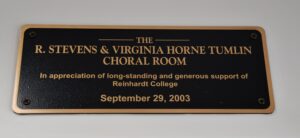
The Tumlins honored their grandson with a contribution to Reinhardt. In a letter dated November 12, 1996, then President Floyd Falany suggested the No Greater Love Award. “I would like to propose that we award, annually, [a scholarship] in the spring, to a student, honoring their exemplary participation in community service projects… [The student] would be given the Greater Love Award, in memory of Chip.” Thus began an important Reinhardt tradition. In addition to this award the Tumlins were generous in other ways and the University honors them with naming the R. Stevens and Virginia Horne Tumlin Choral Room in the Falany Performing Arts Center as well as the R. Steven Tumlin, Sr. Scholarship Endowment.

The Young Singers of Flint Hall rehearsing in the R. Stevens and Virginia Horne Tumlin Choral Room.
Fredrick Raymond Stevens Tumlin (1916-2003) was born in Atlanta and attended the University of Georgia, Georgia Institute of Technology, and Atlanta Law School (closed 1994). His father, brother, and he opened Marietta Lumber Company in 1934 which operated until 1988 (even surviving a 1965 fire that destroyed most of the plant). In 1942 he married Virginia Horne. That same year he joined the Air Force and served until 1945. His civic and philanthropic leadership was well known during his lifetime. He was one of the founders of the Kennesaw State University Foundation, Director of First Railroad Bank Company in Augusta, president of Marietta Kiwanis Club, president of Marietta High School PTA. He also served on the YMCA Board of Directors and Advisory Board of Marietta Educational Garden Center. At his church, First United Methodist of Marietta, he served as Sunday School Fellowship Class President, Chairman of Commission on Education, Chairman of Commission on Finance, Vice Chairman of Official Board, Chairman of Official Board, planning Commission of church (1959-1963), Building Committee, Chairman of Board of Trustees. Tumlin was also a member of the Reinhardt University Board of Trustees where he served as board chair.
 Ann “Virginia” Horne Tumlin (1919-2007) was highly active in the community and lauded for her leadership. She was president of Georgia Mothers Association, president of PTA at Allgood, Westside, Marietta High School, and City-Wide Council, a Girl Scout and Cub Scout Leader, president of Cobb County Girl Scouts Council, founder and president of Marietta and Cobb Beautification, president four times of Honeysuckle Garden Club, and president of Cobb County Garden Club Council. She received Liberty Bell Award from Cobb Bar and was the first female to be Cobb Citizen of Year by Cobb Chamber. She was also active in her church as a Sunday School Teacher, a Choir Leader, a member of the Board of Stewards, and Missions chairman.
Their children are Harriet Koella (previously mentioned) and R. Stevens “Thunder” Tumlin, Jr. Thunder served as a member of the Georgia House of Representatives representing District 38. He currently serves as the mayor of Marietta (since 2010). Other leadership positions have included chairman of the Board of the Marietta Board of Education, chairman of the Marietta Board of Lights and Water and a member of the Board of Directors of the Municipal Electric Association of Georgia.
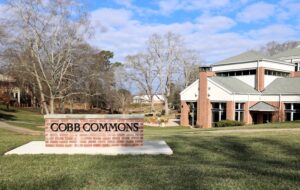 On April 13, 2025, Reinhardt University dedicated Theora Westbook Cobb Commons, the beautifully appointed green space between the Bratton Bell Tower and the Bannister Glasshouse which overlooks Lake Mullenix. Theora Westbook Cobb came to Reinhardt by wagon from Hickory Flat, after her husband’s untimely death. From there, the history of the Cobb family and Reinhardt became inexorably intertwined. At the Cobb Commons’ dedication, Theora’s great-granddaughter, Susan Turner, recounted her family’s connection to and love of Reinhardt. The following are some of the remarks created by Susan and her sister, Mary Anne Turner Browne, for the occasion.
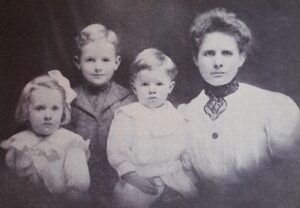
Ella Mae, Lawrence, Charles, and Theora Westbrook Cobb. (Reinhardt University Archives)
“It is a true honor to have this beautiful space named and dedicated to Theora Westbrook Cobb, my great-grandmother. I’ve heard about Reinhardt University over the years but have learned much more since learning about The Commons. In 1883, when this school was founded, it was known as Reinhardt Academy, later to become Reinhardt College, and now Reinhardt University. As a college, Theora served it as the school’s librarian. From an article in a school publication some years ago, I learned that the school was unable to give her a salary, but that she would be compensated with a $15 a month allowance so that her three children could have speech and piano lessons.
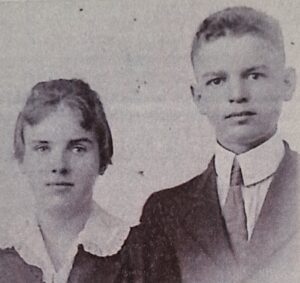
Ella Mae and Lawrence Cobb. (Reinhardt University Archives)
All three of Theora’s children, Lawrence, Ella Mae, and Charlie, attended Reinhardt College. As alumni, each served Reinhardt in varying capacities. Lawrence served on the Board of Trustees and managed the College’s farm which was approximately 500 acres. He was recorded as having said, ‘I walked all the lines and knew every fence post and which ones needed staples. When they did, I’d go to Luther Cline’s store and buy them…and go put them up.’ The farm provided employment for students working their way through school. It also produced a large portion of the food needed in the dining hall. Perhaps most importantly, Lawrence donated stock certificates which were used to build a scholarship fund in memory of Theora Cobb.
One other way that Lawrence supported Reinhardt is by donating athletic equipment. In fact, the first time that I heard about Reinhardt was when I was on a garage sale hunt with Lawrence. Of course, I called him ‘Grandpa.’ As Grandpa drove, I sat on the fold-down console between the two front seats…like I was riding a horse. It’s hard for me to believe that I’m old enough to remember a time when cars had no seatbelts! As we rode, we sang, ‘In the Good Ole Summer Time.’ Funny what the memory recalls. When we got to the sale, Grandpa saw several golf clubs stacked in the corner of the garage. I don’t remember exactly what they were asking for them, but it wasn’t much, so when Grandpa started negotiating for a lower price, I was very embarrassed. No doubt his thriftiness was one of the reasons he was able to generously support Reinhardt as well as his beloved United Methodist Church. When I got home from the garage sale, I asked my mom why Grandpa would want so many golf clubs. ‘Oh,’ she said, ‘He buys all kinds of sports equipment and donates it to Reinhardt College.’ She continued by saying, ‘Not long ago, I saw him take a new pair of shoes for one of the custodians whose shoes were worn out. Even as a little girl, those kind gestures were not wasted on me.
Following her education at Reinhardt, Ella Mae went to the University of Georgia to earn a teaching degree. She spent 44 years in the school system before retiring in 1966. While teaching in Canton, she ironically had an opportunity to teach a third grader named Charles Cobb, Jr., her nephew.
Because of her love for students and their education, it is no surprise that Ella Mae’s offering to Reinhardt was through her mother’s scholarship fund. Though only on a teacher’s income, she was able to be extremely generous to many individuals whom she seldom met. Her brothers credited this to Ella Mae’s investment savvy and her remarkable discipline with money, to which Ella Mae replied, ‘I wanted to do something for young people who couldn’t afford to attend college otherwise.’
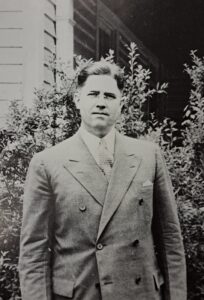
Charles Cobb, Sr. served on Reinhardt’s Board of Trustees for over two decades. (Reinhardt University Archives)
Charlie Cobb served on Reinhardt’s Board of Trustees for 20 years. He held the office of vice chairman and frequently presided over the board in the absence of the chairman. At one point, the college faced some of its most difficult times. Student numbers began to fall. There was talk of closing the school or combining Reinhardt with another institution, but the Cobbs would have none of it. Charlie and Lawrence were instrumental in guiding the school through these challenges. No doubt, Charlie’s resilience in the face of such adversity served him well as he went on to serve as president of the Lion’s Club, co-president of the local PTA with Ella Mae, Administrative Board President of the First United Methodist Church of Canton, President of Canton Cotton Mills, a member of the Water Commission and eventually mayor of Canton.
All three siblings were successful investors, especially through the stock market. I was on another outing with Grandpa when he stopped at Lenox Square. I vividly remember he and I sitting on a concrete wall and staring up at the side of a building which might have been Rich’s or Davidsons, and I was totally bored. What were these letters and numbers and dots that were coursing across the building? Much later in life, I learned that it was called a ticker tape with stock quotes and trades. Even though I was clueless about the stock market then (and still am), I’m proud that the Cobb siblings’ knowledge of the market and their generous hearts ultimately benefited so many students here at Reinhardt.
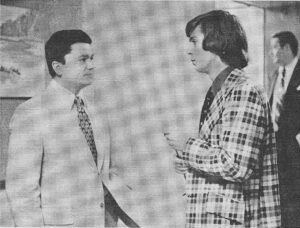
Charles Cobb, Jr. (left) speaks with student Stuart Greene (RU-1975). (Reinhardt University Archives)
Charlie Cobb had a son named Charles Cobb, Jr. He too was very involved in the life of Reinhardt. Though having attended Georgia Tech and Harvard, Charles Jr. spent a great deal of his energy serving Reinhardt. When his father was vice-chairman of the Trustees, Charles Jr. joined the Board as a way of spending more time with his father. Over time, however, he developed a personal connection to Reinhardt and served on the Board for a total of 40 years. He also served as Chairman of the Finance Committee and Treasurer of the Executive Committee.
Charles was tickled when about a year ago, I [Mary Anne] emailed him that my husband, his sister and brother-in-law, and I were going to take a day trip to the Elijay/Jasper area and make a quick stop at Reinhardt on our way up. Much to our surprise and great pleasure, we never made it out of Waleska! When we arrived at this campus, we were met with quite the welcome from Ms. Bowles and several others! We had a delightful time of conversation with Dr. Roberts, and then we were served a fabulous lunch! We ended our visit with a personal tour of the entire campus. Obviously, Charles was behind this grand reception. He thought so highly of Reinhardt and wanted us to experience just a piece of why he loved it so much. We are happy that Charles Jr.’s son, Charlie Cobb, III, could be here today.
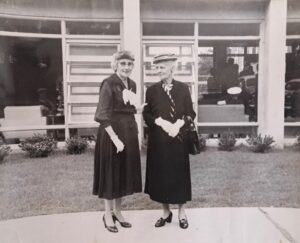
Katherine Gordy and Theora Westbrook Cobb in front of Smith Johnson Hall. (Reinhardt University Archives)
In closing, I’d like to share one last story. When I was a little girl, I often went to my grandpa’s house on Piedmont Road, and sometimes I would go across the street and go swimming in the neighbor’s swimming pool. Many years later, I learned that that same house had been donated and moved to the Reinhardt campus! Some of you might have parked beside that house tonight…it belonged to Evelyn and Frank Gordy and is now the Evelyn Gordy Hospitality House. Even more ironic is that some years later, my husband’s youngest brother married Evelyn Gordy’s granddaughter! It seems that Reinhardt was destined to be a part of our families!
If Theora was here, I am quite sure that she would be humbled and proud of the Commons dedication today. She would be grateful that her children and grandchildren chose to support the ongoing education of so many students. It is my hope that the Theora Westbrook Cobb Commons will bring lots of pleasure to its students…a place to laugh, a place to fellowship, a place to rest, and perhaps even a place to study.”
A common question. A common refrain. The Hoke O’Kelley belies its purpose as just a large room on campus used for gatherings to represent much more. Once used as a chapel, the auditorium now serves as host to farewell receptions for long-serving employees, annual celebrations of donors, and a vast array of presentations for admissions, academic affairs, and student life.
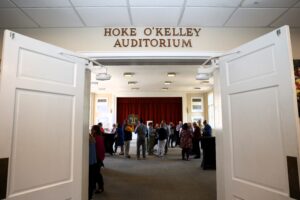 The Hoke O’Kelley has a certain presence upon entering the main doors of the Martha S. and James R. Burgess, Jr. Administration Building, built in 1951. Straight ahead are its double doors. Marked above them in old, austere, plain (and a little wobbly) black letters read, “Hoke O’Kelly Auditorium.” Walking through the doors one takes a breath to marvel at the towering ceiling, worn wood of the stage, and glorious views of grand trees afforded by the large windows. The subtle aroma of age lingers like the comforting scent of a grandparent’s home or old schoolhouse. It is not a polished, well-appointed nor luxurious room, but its simplicity holds ineffable charm of days gone by as if to convey the adage, “if these walls could talk.” One might even say The Hoke O’Kelley is the heart and soul of campus tethering us to the University’s past as traditions continue and as new ones emerge.
The place, its purpose, and its central role in celebrating history, perhaps overshadows its namesake today. Who was Hoke O’Kelley?
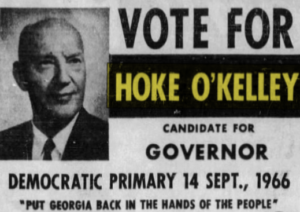
(Reinhardt University Archives)
Hoke Smith O’Kelley (1895-1969) was born in Walton, Georgia to Permetus M. and Annette L. Hopson O’Kelley. He earned degrees from North Georgia College (now University), the University of Georgia, and Columbia University, and New York University, where he earned his Doctor of Jurisprudence in 1927. He married Ola Jewell Jackson (1907-1993), and they settled in Loganville where he was an attorney and, later, mayor of Loganville and chairman of the Board of Education.
He served with distinction in both World War I and II. In WWI, he directed artillery fire while riding in a observation balloon. In WWII, he fought in the Battle of the Bulge and was injured when his jeep hit a land mine. Thanks to the efforts of his sister, Willie O’Kelley DuBois, he was posthumously awarded a Purple Heart in 1984. His final military rank was as major.
Known for his wit, enthusiasm, and manners of a gentleman, O’Kelley unsuccessfully ran for governor five times between 1932 and 1966. His obituary printed in the February 4, 1969, edition of the Atlanta Journal Constitution noted, “Those who knew him well said that O’Kelley realized he didn’t have much of a chance, but he deeply resented the idea that he was not a serious candidate. He poked jabs at ‘the big money boys’ but never personally attacked his opponents in his speeches and propounded any major platforms.”
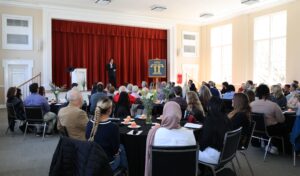
Throughout the year, a variety of events are held in the Hoke O’Kelley Auditorium.
In his last will and testament, he created a trust to support his wife, her sisters, and his sisters as well as the educational aspirations of students at Andrew College, Reinhardt College, and Young Harris. When all was settled, Reinhardt received many hundreds of thousands of dollars, which is why Reinhardt continues to honor his name today. Reinhardt also owes a debt of gratitude to his sister, Willie David O’Kelley DuBois (1893-1988), who established an endowment through a bequest from her estate in 1988.
In the early 1900s, J. W. Holmes and his wife, Isabel, moved to Waleska from Atlanta so they could pursue their education. He was pursuing his dream to become a Methodist minister. Two weeks before he was to graduate from Reinhardt in May 1909, his appendix ruptured, and he died. He was to be admitted into the United Methodist Conference that summer. Since he had not yet been admitted, Isabel was left without a pension. She was also left to raise their three-year-old, Eulene, and a newborn, Ethel alone, and so, Isabel returned to Atlanta.
When Isabel learned that R.C. Sharpe had returned to be Reinhardt’s president, she contacted him and asked for a job so that she could finish her studies. Sharpe invited her to live on campus with her two children, attend school, and serve as a pastry chef in the dining hall. She later went to work in the library and worked there for years, and became well known in Canton as an accordionist.
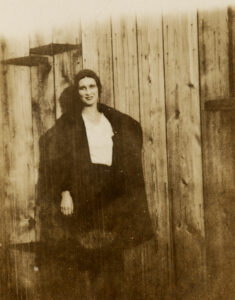
Eulene Holmes Murray (RU-1924). (Reinhardt University Archives)
Eulene and Ethel attended Reinhardt Academy. Eulene’s piano teacher was Kate Gordy, the mother of classmate Frank Gordy (RU-1924) and grandmother of Nancy Simms. Frank Gordy was the founder of The Varsity restaurant. Nancy Simms assumed the leadership of The Varsity following his death and until passing the reigns to her son, Gordon Muir. The Gordy and Simms families have left a lasting legacy at Reinhardt.
In 1921, at the age of 15, Eulene went to nearby Lathemtown, Georgia to live with “Lizy” Lathem and teach music to the Lathem daughters. Any of the other families in the neighborhood could pay the Lathems and their children could take music as well. After graduating from Reinhardt in 1924, Eulene moved to Atlanta where her first job was at a ‘five and dime’ store demonstrating sheet music. She also played music for parties and weddings and served as an accompanist for ensembles throughout Atlanta.

(Reinhardt University Archives)
Sometime around 1930, she met and married a young widower named Stuart Paul Murray (1892-1978), who owned the Atlanta Beverage Company. After she married Stuart, he became a gentleman farmer in addition to running his successful business. Their first farm was in Smyrna, where they lived on the weekends. He later developed the farm into the Belmont Hills Shopping Center, which opened in 1954 with great fanfare and an appearance by Georgia’s 1953 Miss America, Neva Jane Langley. At the time, the Atlanta Constitution Journal noted it as the largest center in the Southeast.
During the week, the Murrays resided in a suite at the posh Atlanta Biltmore Hotel and, later, in a home on Valley Road in Atlanta. The Atlanta Biltmore, which included both suites and apartments, had opened in Midtown in 1924 and was developed by William Candler, son of Coca-Cola founder Asa Candler, along with Holand Ball and John McEntee Bowman. Today, the building is owned by Georgia Tech.
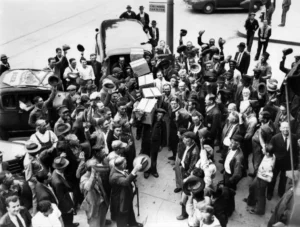
A crowd in Marietta, GA celebrates the end of prohibition. Courtesy of Special Collections & Archives, Georgia State University Library, Atlanta Journal-Constitution Photographic Archive.
Stuart Murray championed the end of Prohibition and lobbied for the legalization of the sale of alcoholic beverages in Georgia. Prohibition in the U.S. banned the manufacture, sale, and transportation of alcohol from 1920-1933 as the result of the 18th Amendment to the U.S. Constitution and the Volstead Act. In 1935, the Georgia legislature approved the Alcoholic Beverage Control Act calling for a referendum and tasked the State Revenue Commission with creating regulations for the sale and distribution of alcohol. This change was a great boon for the Atlanta Beverage Company and the Murrays’ financial success.
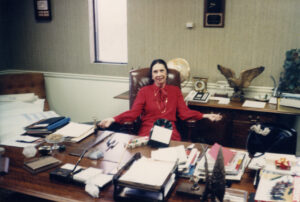
Eulene Holmes Murray in her office. (Reinhardt University Archives)
Eulene supported Stuart’s business and leadership efforts. When he died in 1978, she continued to lead the Company as president for many years. Today, the company is one of the largest U.S. distributors and is still family-owned.
Mrs. Murray was known for her beauty, charm, intelligence, talent, wit, and, of course, her love of Reinhardt. Notes from Advancement staff visits left in Reinhardt records leave a smile with anyone who reads them. On one occasion, Mrs. Murray played the piano for more than 15 minutes exclaiming she wasn’t very good even in the face of staff members’ protests that it had been excellent. On another occasion, when she was asked for a contribution, she stated, “I thought you were going to ask me to build an annex or something.” When the staff member explained that President Falany would be coming back with Vice President JoEllen Bell to talk to her about the College’s capital campaign, she jokingly said she expected to be “real busy” when they called. Nevertheless, she was exceedingly supportive and always generous to Reinhardt.
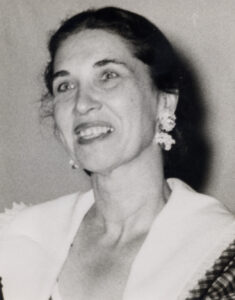
Reinhardt’s Department of Music is named in honor of Eulene Holmes Murray. (Reinhardt University Archives)
In honor of Eulene Murray’s devotion to and support of Reinhardt, the University named the Department of Music for her in 1999 shortly before her passing. The Stuart and Eulene Murray Foundation continues the Murrays’ legacy of leadership and a love of education by making contributions for scholarships at Reinhardt. Reinhardt is truly fortunate to have known and inspired such an exceptional human being, Eulene Holmes Murray (1906-2000).
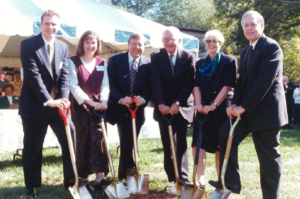
Groundbreaking of the Falany Performing Arts Center, from left: Eulene Murray’s great nephew Michael Williams (RU-1991), Murray’s great niece Leslie Ann Williams (RU-1993), Dr. William Nevious, Dr. Floyd Falany, Fay Falany, and Ronnie Hopkins. (Reinhardt University Archives)

The cover of a scrapbook created by Carfax Baxter. (Reinhardt University Archives)
Nestled away in the Hill-Freeman Library archives lives a scrapbook created by a beloved sister for her brother, inscribed, “The Possible History of the Life of Mr. Joseph W. Baxter 1911.” The volume’s sweet words, accompanied by photographs and snippets of popular sentimental illustrations and advertisements, speak of admiration, nostalgia, and (perhaps) a romanticized account of Joseph Baxter’s young adult life by a devoted sister, Carfax Baxter. (Yes, Carfax is a real name and is not associated in any way with the company known today. The name comes from the Middle English “carfukes” (crossroads), which is an Anglicization of Latin “quadrifurcus” (four-pronged, four-forked road).
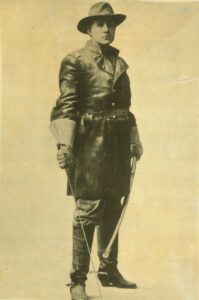
A scrapbook photo captioned “Joe as a cow-boy.” (Reinhardt University Archives)
The scrapbook regales a young man of promise attending Yale University, stories of love and marriage, and success in New York City. Who was Joseph W. Baxter, and how was he associated with Reinhardt?
Joseph Woodward Baxter was born in 1892 and grew up in Suwanee, Georgia. From his sister’s scrapbook, it could be gleaned he lived a privileged life with ample hobbies to busy his time, family trips to the shore, and boarding school. At Yale University, he participated in a variety of sports from tennis, golf, croquet, to other activities. After graduating with first honors, he set out with a friend to vacation in the American West—a photo, presumably taken on the trip, shows him with boots and spurs captioned “Joe as a cow-boy”. Following his travels, Baxter became a banker in New York City.
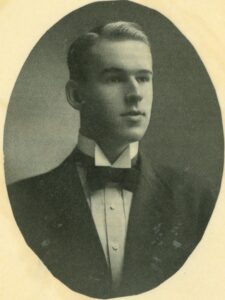
Joseph W. Baxter graduated with first honors at Yale. (Reinhardt University Archives)
In the scrapbook, it notes he married his sweetheart, Vivian Fornoy, but there is no record of her elsewhere. Other records mention a woman he married in 1929, who sadly died in 1937. After her passing, Baxter returned Georgia where he opened a bargain store in Jefferson. In 1944, Reinhardt’s President J. Rowland Burgess visited him and asked for a $350 contribution. Baxter offered $10. The next year when President Burgess asked again, Baxter allegedly said, “I’m going to surprise you today. I’m going to cut you in half,” and gave him $5. Undeterred President Burgess sent Baxter a pamphlet entitled, “The Importance of Making a Will.” In response, Baxter suggested to President Burgess that his attorney, Jack Davidson, be appointed to the Board of Trustees for Reinhardt because, “someday you might have some dealings with him.” President Burgess made sure Davidson was selected and he served as a trustee from 1962-2000.
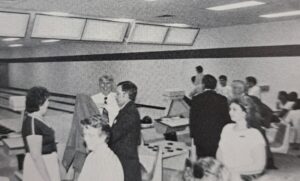
Reinhardt’s bowling alley on the Baxter Center’s dedication day in 1988. (Reinhardt University Archives)
Throughout his life Baxter was active in his community, frequently supporting local events and charities such as the Red Cross of Jackson County, the Civic Improvement Club, and the War Advertising Council during WWII, as well as the Golden Cross, a charity associated with the Methodist Church that provided hospitalization and treatment for those that could not afford care. Ultimately, Baxter became a champion of Reinhardt. On May 18, 1988, the Joseph W. Joseph W. Baxter Physical Fitness Center was dedicated (complete with a bowling alley which Baxter adored). At the ceremony, Reinhardt President Floyd Falany remarked, “Mr. Baxter is a devoted churchman with a keen interest in the welfare of young people. His belief in the College and dedication to its concern for the development of the whole person prompted him to make the extremely generous gift which has made possible the construction of this facility.”
When Baxter passed away, he left a great amount of his fortune to Reinhardt in addition to the $1.3 million for the fitness center. It seemed that President Burgess’ efforts, the University’s good works, and a little pamphlet had made a difference. Today, Reinhardt also recognizes him with Baxter Avenue and Baxter Circle named in his honor.
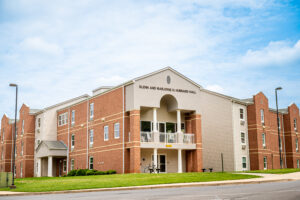
Glenn and Marjorie H. Hubbard Hall
Hubbard Residence Hall, affectionately known as Hubbard Blue and Gold (HBG), has become the home away from home for many students since its opening in 2012. Its suite-style accommodations, commons area, and balcony make for lively and spirited living. Organized into three areas—Hubbard, Blue, and Gold—the space provides rooms for women (Hubbard), men (Blue), and Gold (used alternatively for women or men depending on campus needs). For donors, and the residence’s namesake, Glenn (RU-1936) and Marjorie (RU-1937) Hubbard life on campus is much different from when they were students. Marjorie once noted, “I remember when men and women were not allowed fraternize!” Times have changed but love of community never wanes. Here’s the Hubbard’s story and how they loved Reinhardt and their community in tangible ways—service, generosity, and creativity.
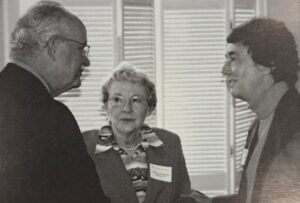
Marjorie Hubbard (center) received the Evelyn Gordy Alumni Loyalty Award in 2003. (Reinhardt University Archives)
Just prior to her passing in 2017, Marjorie Humphrey Hubbard (RU-1937) had the honor and distinction of being Reinhardt’s oldest living alumna. Born in Ball Ground, Georgia in 1916, she attended Reinhardt in the late 1930s. Before receiving her degree in 1937, she embarked on her teaching career instructing a math class for the high school on campus at the request of Reinhardt’s Dean. After graduation, her career began in earnest as she taught at Etowah School in the Hightower Church area where she made 60 dollars per month.
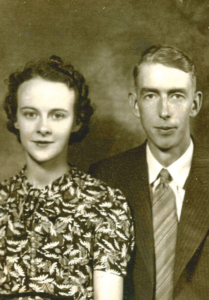
Marjorie and Glenn Hubbard. (Reinhardt University Archives)
She later moved to New Bethel School where she met another teacher, Glenn Hubbard, also a Reinhardt graduate from the class of 1936. They married in 1940 and settled in Woodstock. She taught at Woodstock Elementary School until her retirement in the mid-1970s. Glenn later worked for Bell Aircraft Corporation during WWII, returned to teaching, and then started a career in accounting in 1950 until his retirement in 1980. Glenn served as a Woodstock City Council Member and as the City Clerk and Planning Commission Member. During his lifetime he was recognized with several community awards. Glenn and Marjorie were married for 62 years. Their daughter, Elaine, was also a generously supporter of the University. In total, their support has provided millions of dollars for scholarships and the construction of HBG.
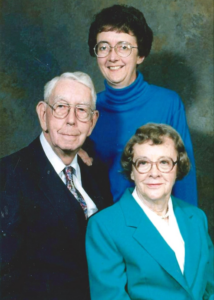
Pictured from left: Glenn, Elaine, and Marjorie Hubbard (RU-1937). (Reinhardt University Archives)
The Hubbards loved Reinhardt and they were pillars of the community. Their Woodstock home was also well-known for a special backyard feature that has been since preserved by the City— a small hand-constructed mini-lighthouse Glenn built which attests to his mindfulness about history and place. Juanita Hughes wrote in “Lighthouse Memories Shine Beacon on City’s History” for the Cherokee Tribune on September 4, 2013:
“Somehow, for the first time in my memory, I asked about the lighthouse, how it came to be. Turns out it is yet another example of historic preservation. It goes back to Glenn’s boyhood on the family farm which was located in the area of today’s Hobgood Park on Bells Ferry Road.
Rose Creek flowed through the farm, and Glenn’s father panned for gold there. Glenn attended the one-room Othello School. One of his friends was Charlie Poore. The two of them, along with other boys in the area, organized the Night Owl Christian Club, and it was there that the boys learned and put into practice those attributes that would serve them well in adulthood… adherence to the club’s by-laws and code of ethics, prompt payment of dues, regular attendance at meetings, and participation in debates on such timely subjects as trains vs. automobiles, Woodrow Wilson vs. Abraham Lincoln, and timber crops vs. cotton crops.
Glenn’s friend Charlie was a talented artist and craftsman, and when Charlie built a lighthouse at his home many years later, Glenn took note. He gathered rocks from his father’s farm, from the creek bed of Rose Creek, and from the foundation of the old Othello School, and fashioned his own lighthouse.”
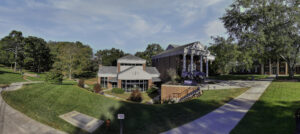
The Jewell Wyatt Bannister Glasshouse
Situated below the Hasty Student Life Center, students, faculty, staff, and visitors find a beautifully appointed room used for meetings, luncheons, lectures, student gatherings, and worship services. Once the location of an outdoor pool, the landscape now features a space with two-story high windows on three sides affording breathtaking panoramic views of the treelined Theora Westbrook Cobb Commons, the Dr. W.M. and Lucy Bratton Bell Tower, Herbert A. Mullenix Lake, and, in the distance, The Floyd A. and Fay W. Falany Performing Arts Center. This space, aptly known as the Jewell Wyatt Bannister (RU-1940) Glasshouse, is not only physically connected to the Hasty Student Life Center, but both namesakes are related.
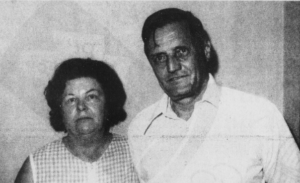
Jewell and Lanier Bannister. (Reinhardt University Archives)
Jewell Wyatt Bannister (1920-2006) attended Reinhardt and played on the women’s basketball team. After earning an associate’s degree, she completed her undergraduate degree at North Georgia College (now the University of North Georgia) and became a teacher. Most of her career was at Cumming Elementary School where she taught from 1957 until her retirement in1974. Jewell was married to Julius Lanier Bannister (1920-2001). Together, they served on the Forsyth County Retired Teachers Association (Jewell was Telephone Chairperson and Lanier was Legislative Chairman) and both were presented with Community Service Award Certificates in 1994. They also served on the Diabetic Steering Committee at Lakeside Community Hospital. In her last will and testament, she bequeathed a large contribution to Reinhardt which helped to build the facility. The Jewell Wyatt Bannister Glasshouse, dedicated on March 12, 2008, continues to honor her memory.
She is connected to the Hasty family through her beloved sister, Hazel Wyatt Hasty (2024-2009), also a schoolteacher. Hazel was married to William Hasty, Sr. (1922-2003), who served as Cherokee County School Superintendent and as a Georgia State Representative and Senator. He was also an alumnus of Reinhardt. The Hasty Student Life Center is named in honor of William G. “Billy” Hasty Jr., Linda N. Hasty, and Hazel W. Hasty.
William G. Hasty, Jr. (RU-1967) is currently an emeritus member of Reinhardt’s Board of Trustees. During his distinguished law career, he served as Senior Partner and Attorney, Hasty Pope LLP, in Canton, Georgia. During his career, he has attained jury verdicts in cases involving exposure to pesticides and successfully represented plaintiffs in the L-Tryptophan litigation against Showa Denka Ltd. He represented and litigated for municipal and county governments for more than 20 years, including Cherokee County, City of Canton, Cherokee County Development Authority, Cherokee County Water and Sewerage Authority, Cherokee County Hospital Authority, Cherokee County Board of Education, and the City of Ball Ground. Hasty has served several organizations, such as Phoenix Society of Atlanta, American Trial Lawyers Association, Bank of Canton Board of Directors, Leadership Cherokee, Leadership Georgia, and the Hospital Board of Cherokee County.
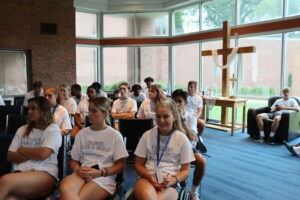
New student orientation (above) and student involvement fairs (left) are just some of the ways the Bannister Glasshouse is enjoyed.
The Bannister Glasshouse and the Hasty Student Life Center were designed by architect Garland Reynolds (1935-2024) of Gainesville, Georgia. Reynolds also designed Reinhardt’s William W. Fincher Jr. and Eunice L. Fincher Visual Arts Center, the F. James and Florrie G. Funk Heritage Center, and the Floyd A. and Fay W. Falany Performing Arts Center.
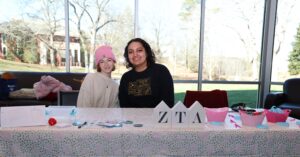
(Reinhardt University)
It’s often remarked to never underestimate what can be accomplished when a group of people recognizes a need and joins efforts to see a task through to completion. Reinhardt beautifully evidences this old adage. The institution’s founders knew this when they sought support from the United Methodist Church. President Burgess knew this when he invited the community to Soil Conversation Day in 1949. Alumni and friends know this when they make contributions to support the University. Just about everything on Reinhardt’s campus can be attributed to an unwavering community spirit. The President’s home, named for Hal. B. Wansley, is another such example.
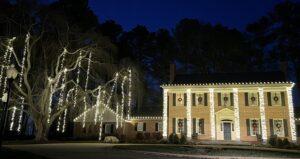
The Hal B. Wansley President’s Home. (Reinhardt University)
Located at one of the highest points on campus sits a Georgian two-story colonial home built in 1977. Modeled after Belle Meade, the home of former Board of Trustees Chair, Peter S. Knox, Jr., it overlooks the campus and the foothills of the Blue Ridge Mountains. In the January 1978 Reinhardt Report, the house was described much as it remains to this day (with the exception of the color of the shutters which are now black), “A circular driveway gracefully approaches the beautifully landscaped hone through stately oaks that has been a part of campus since the college’s founding by Captain Reinhardt in 1883. The home is of red brick and off-white trim and dark green shutters, and has a spacious six-columned front porch.”
The 1978 article continues, “The Hal B. Wansley President’s Home on the Reinhardt College campus is a dream come true. It is a functionally designed home that will serve the college and its present for years to come and is a monument to all those who so graciously gave of their resources and time.” Contributors to the project included the W. I. H. and Lula E. Pitts, Paul Jones, and John and Mary Franklin Foundations and Alvin Barge, Ruth Wansley, Jones Mercantile of Canton, Bank of Canton, Merry Brick and Tiles of Augusta, Augusta Lumber, Tom Addison, Haynes Lumber Company of Canton, Thomson Oak Flooring of Thomason, and Whitecrest Mills of Dalton, along with many others. Board of Trustees member Pete Knox contributed over one-half of the cost of construction.
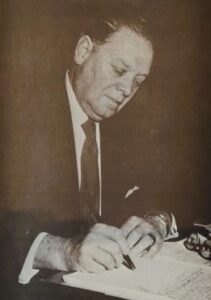
Hal B. Wansley. (Reinhardt University Archives)
The home is named in memory of Hal Brantley Wansley (1913-1975) who was born in Carnesville, Franklin, Georgia to John Wesley Wansley and Mary Beatrice McCarter. He married Leona Ruth Simpson. Wansley served as a lieutenant in the US Marines in World War II. He landed in Iwo Jima on D-Day and fought on the front lines for 13 days (four without food). About the battle he once stated, “I never expected to witness something so ghastly.” After returning home, he had a career at Georgia Power and became an executive there. A power plant in Heard, Georgia, was also named in his honor. He was the Chair of the Reinhardt Board of Trustees from 1973 to 1974 and Vice Chair from 1974 to 1975.
Following his death, Wansley’s wife, Ruth Dunaway Wansley (1914-2012), served as a member of the Board of Trustees from 1976 until 1992. In addition to her role as a trustee, she (along with Elizabeth Johnston and Lucretia Mount) served on the committee to furnish and decorate the President’s Home.
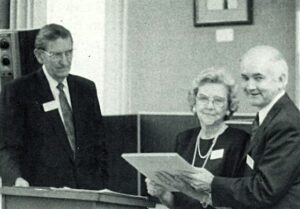
Pictured from left: Board of Trustees Chairman Normal W. Pachall, Ruth Wansley, and President Floyd A. Falany. (Reinhardt University Archives)
Ruth was born in Tallapoosa, Georgia to Florence Corinne and Reverend Charles M. Dunaway. She graduated from Asbury College. She married her first husband, John Reuben Montgomery, in 1934. They had three daughters, Kim, Karen, and Katie. Karen married John Erlichman, an aide to Richard Nixon. Ruth married her second husband, Hal, in 1966 and they raised three sons, Hal Jr., James, and John. She served in leadership roles in the Methodist Women’s Society and United Methodist Women. She was a member of the Rome First United Methodist Church, Adult Fellowship Sunday School Class, Rome Symphony Guild, Asbury College Alumni Association, and Rhododendron Woman’s Club. She served as a wedding coordinator at Rome First UMC.
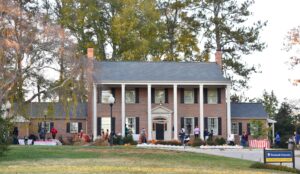
A Fall event being hosted at the Hal B. Wansley President’s Home. (Reinhardt University)
The Hal B. Wansley President’s Home was first used by President Allen O. Jernigan for his family and well as a location for special events. (Students sometimes left their mark on the home and grounds as documented in the 1979 yearbook when trees were covered in toilet paper.) Today, the President’s continues to be a hub for meetings and special events throughout the year hosted by President Mark Roberts.
Who was the man whose vision and generosity were the difference between hope and failure in the mind of former Reinhardt President Floyd Falany? Who was the man who drove by the campus and felt an immediate connection that inspired him to contribute? What is his legacy at Reinhardt?
In a letter dated March 17, 1993, from President Floyd Falany to a donor who had established a scholarship and made contributions for a new academic building, Dr. Falany wrote,
“We are an enthusiastic group that works hard to provide quality instruction, beautiful facilities, and a caring, friendly atmosphere for the young men and women of this generation. But we can only dream as much as you will allow us.
“Your kindness is the difference between hope and failure for many students. We all wonder whether our gifts really do make a difference. There are dozens of students in class at this very moment who would gladly shake your hand with gratitude and tell you with pride and excitement about all you have done for them.
“Somewhere, years ago, we all benefitted from the attention given to us by a special person in our lives. Many of us don’t even know who that person was. You have repaid a great part of that debt with your unselfish gift to Reinhardt. Your continued support will only add to the legacy you have begun.”
This letter penned to George M. Lawson more than thirty years ago still rings true. Lawson’s contributions provided funds for a building, a scholarship endowment, and art enjoyed in various locations on campus. The campus continues to benefit from a man with a belief that providing hope was an important part of helping others be and do their best.
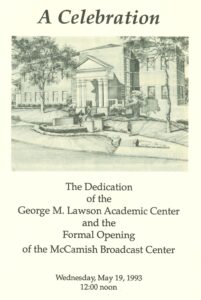
(Reinhardt University Archives)
Dedicated on Wednesday, May 19, 1993, The George M. Lawson Academic Center, located between the Martha S. and James R. Burgess, Jr. Administration Building and Blanche and Harold T. Hagan Chapel, remains central in the life of the mind at Reinhardt. Originally, the state-of-the-art facility housed classrooms, faculty offices, computer labs, the McCamish Business School and Broadcasting Center, a Center for Entrepreneurship and Free Enterprise (CEFE), and the Academic Support Office. The building and programs were a part of the efforts for Reinhardt to become a four-year college and touted at the time as “the new cornerstone of quality instruction at Reinhardt College.” Although the McCamish Broadcast Center is now located in the Falany Performing Arts Center, the Lawson Academic Center continues to house faculty offices and classrooms. The Lawson Academic Center was designed by Kirkman Associates Architects of Dalton, Georgia, and built by P.R. Orton, Inc. of Chamblee, Georgia.
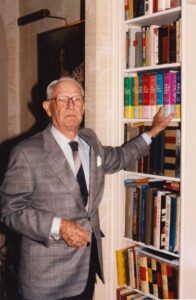
George Lawson. (Reinhardt University Archives)
George Lawson didn’t attend Reinhardt but became aware of Reinhardt College as he passed back and forth to what was formerly known as Lake Arrowhead Resort and once said, “The more I saw of the school and the president I was convinced” to join its efforts. He also knew of Reinhardt from his friend and fishing buddy, D.W. Brooks, who had “said nothing but good things.” Lawson established an endowed scholarship in his friend’s name. David William (D.W.) Brooks (Georgia, 1901-1999) was a graduate of the University of Georgia and known for his work helping farmers by starting an agricultural cooperative in the early 1920s which after several iterations later became known as Gold Kist. Brooks served as an advisor on agriculture, economics, and trade to seven U.S. presidents. He was a long-serving member of Reinhardt University’s board of trustees (1954-1999).
Pictured: Rachel Crittenden (RU-2025) enjoys a quiet moment reading amongst art given by George Lawson and displayed in the JoEllen Bell Wilson (RU-1961) Office of Advancement.
Lawson also contributed several dozen works of art, primarily paintings from the 18th, 19th and 20th Centuries. The works can be seen in several locations on Reinhardt’s campus including the JoEllen Bell Wilson (RU-1961) Office of Advancement, offices in the Martha S. and James R. Burgess, Jr. Administration Building, Hill Freeman Library, and the Hal B. Wansley President’s Home. The gift represents Lawson’s love of arts and culture. He believed in the power of art to inspire hope, beauty, and the power of the human imagination.
George Matthews Lawson (1908-2007) was born in Atlanta, Georgia to William Henry Lawson, a lawyer at American Telephone and Telegraph, and Mary Mathews Lawson, a former teacher. His obituary in 2007 states in part,
“After graduating from Boys’ High School, Mr. Lawson attended Emory University, where he was a member of Sigma Alpha Epsilon Fraternity. After three years at Emory, he entered Emory Law School, graduating in 1931. He then clerked for two Atlanta law firms before going to work for the Reconstruction Finance Corporation in 1933. His career at the R.F.C. was interrupted by World War II. The morning after the Japanese bombing of Pearl Harbor, Mr. Lawson applied for a commission in the United States Naval Reserve. After stateside duties, he became a lieutenant commander of an amphibious unit, which provided support for naval and marine aircraft based on Okinawa. At the end of WWII, Mr. Lawson returned to Atlanta and worked for the War Assets Administration, which had been created by Congress to dispose of surplus war assets.
“Then, in 1950, he joined the Coca-Cola Company, where he was a part of the legal staff assigned to the Coca-Cola Bottling Company of Chicago. After one year in Illinois, he returned to Atlanta and continued to work as an attorney for the parent company. Mr. Lawson’s career at Coke spanned 23 years until his retirement in 1973 as general counsel of the company. … For the better part of a century, Mr. Lawson was an active participant in the life and culture of Atlanta and the nation…” At the time of his death, he was survived by his wife, Angel Lawson (d. 2011), and several children and grandchildren.
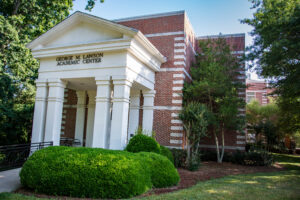
The George M. Lawson Academic Center. (Reinhardt University)
Tucked away in the Southeastern edge of Reinhardt University’s 620-acre property on a small tract of land sits the campus’ wastewater treatment plant. Most people have no idea it exists and perhaps most would rather not even think about the indelicate nature of its purpose. Through the process of filtration, , the facility removes harmful substances and discharges safe water back into the environment. The plant plays a vital role in the operations of campus and without it, the University could not function. No other plant exists in Waleska or the portion of Cherokee County where Reinhardt is located.
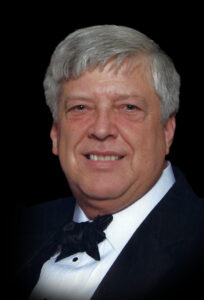
George McClure
Knowing the purpose of the plant, one might think it odd, humorous, or perhaps disrespectful to name it after someone; but the George McClure Wastewater Treatment Plant is no joke. George McClure (1949-2023), an advisor to the Board of Trustees’ Buildings and Grounds Committee for approximately three decades, recognized an upgraded plant was necessary in the 1990s to accommodate additional student housing and championed its construction. Board of Trustees member John Bennett (RU-1965) recalls, “George was very active in the development of Cherokee County ever since the 1970s. His work developing areas like the Towne Lake area of Woodstock gave him the expertise and experience to help Reinhardt with its growth. He helped us in many ways.”
McClure brought significant knowledge to the Board and the Committee regarding construction and waste treatment. In addition to the company (The McClure Companies, Inc.) he operated alongside his wife, Hilda, McClure served on the State Board for Septic Tanks in Georgia until his death and helped write a manual for septic tank regulations in Georgia. McClure was a member of the Cherokee Airport Authority where he served for 38 years, past president of the Georgia Home Builders Association, and past president of the Atlanta Home Builders Association. He was a man who cared deeply for his community and was active in numerous organizations including membership in the Cherokee Shrine Club, Hickory Flat Masonic Lodge # 205, Eastern Star, Canton Jaycees (past president), and Cherokee County Chamber of Commerce (past president).

The George McClure Wastewater Treatment Facility. (Reinhardt University)
When the plant was dedicated in December of 2000, President Floyd Falany surprised McClure by naming it for him. By all accounts,McClure was happy and even chuckled a bit about the distinction. According to President Mark Roberts, “The George McClure Wastewater Treatment Facility is the unsung hero of Reinhardt University’s main campus.”
The story behind the William W. Fincher, Jr. and Eunice L. Fincher Visual Arts Center started long before its dedication in 1998 and continues to this day. It begins with William W. Fincher, Sr. (1876-1959) and Mary Amanda “Mae” Chambers Fincher (1888-1977), both Reinhardt alumni. Fincher, Sr. graduated in 1894 and married Mae Chambers in 1913. He was a pharmacist who was elected vice president of Rexall Druggists’ Association of Georgia in 1924. Mae Chambers graduated from Reinhardt in 1908 and among other activities, she participated in the Woman’s Christian Temperance Union in 1922. Their oldest son, William Wesley “Bill” Fincher, Jr. (1914-2006), was an adamant supporter of providing educational and cultural opportunities for Georgians. The Fincher descendants continue the family’s dedication to Reinhardt by serving on Reinhardt’s Board of Trustees and generously supporting the institution.
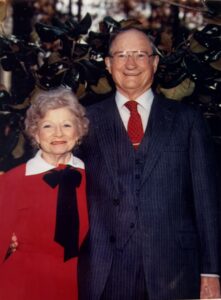
Eunice L. and William W. Fincher, Jr. (Reinhardt University Archives)
Fincher Jr. was born in Cherokee County. He attended Canton High School and completed pharmacy school at the University of South Carolina, following in his father’s footsteps to become a druggist. In 1935, he opened Fincher Drug Company in Chatsworth, Georgia in 1935 along with his brother, Jack. He also joined the First United Methodist Church of Chatsworth (and was a devoted member until his death). That same year, he met Eunice “Peg” Loughridge (1914-2007) and they married in 1936. They had three daughters: Mary Jane, Phyllis, and Frances. After 16 years as a pharmacist, Fincher Jr. sold his drug store and operated a chain of movie theaters in Alabama, Georgia, and Tennessee. Later, his entrepreneurial spirit inspired him to become involved in banking, poultry, and textile businesses.
In 1964, Fincher Jr. was elected to the 54th District of the Georgia State Senate which at that time was made up of portions of Murray, Catoosa, and Whitfield counties. He served for 26 years in the Senate from 1965 to 1991. He was chairman of the Higher Education Committee and the Health and Welfare Committee. He was also a member of the Banking and Finance Committee, Appropriations Committee, Human Resources Committee, and Interstate Cooperation Committee. He was active in a number of local organizations in Murray and Whitfield counties including the Chatsworth-Murray Library, the Whitfield-Murray Historical Society, the Chatsworth Lions Club, the Masonic Order, and Dalton State College among others.
Eunice “Peg” Loughridge Fincher was born in 1914, in Murray County, Georgia, to James Patton Loughridge and Etta Jane Dickey Loughridge. She attended Maryville College and the University of Georgia, after which she taught elementary school in Murray County for several years. Mrs. Fincher joined Chatsworth First United Methodist Church in 1936 and was active until her death. She held almost every church office and taught Sunday School for over 50 years. She was active in the United Methodist Women for nearly 70 years. In addition to her involvement with the church and raising a family, Peg Fincher was an active member of many civic organizations through the years. She was the first Regent of the Robert Loughridge Chapter of (National Society Daughters of the American Revolution) and past president of the Chatsworth Women’s Club. She helped organize the Murray County Band Boosters’ Club. She was one of Dalton State College’s original trustees from 1967-1971. She was a long-time member of the League of Women Voters, a member of the Chatsworth Eastern Star, and a member of the Whitfield-Murray Historical Society.
After Fincher Jr.’s death, his family reflected on his character and values for an April 16, 2006, article by Daily Citizen reporter Misty Watson. His daughter, Mary Jane Peterson, stated he was a giving person and his favorite part of being a senator was being able to help people. The Fincher’s legacy of helping others is evident in the family’s continued support of Reinhardt through generous contributions and through their dedicated service on Reinhardt’s Board of Trustees.
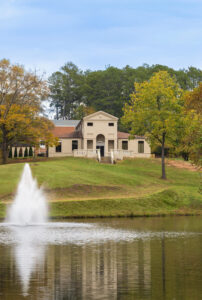
The William W. Fincher, Jr. and Eunice L. Fincher Visual Arts Center. (Reinhardt University)
Mary Jane Peterson’s husband Hugh is an Emeritus Trustee, who began his service in 1980. Hugh Peterson, Jr. served as an officer in the Judge Advocate General’s Corps of the US Army and graduated magna cum laude at Yale University. He joined the King and Spalding law firm and retired in 1992. He was also Chairman and CEO, of VNS Corporation, a building materials company in Vidalia, Georgia. Hugh and Mary Jane Peterson’s daughter, Patience Peterson, is a current member of the Board. Prior to her current position as Assistant Vice President of LexisNexis Risk Solutions, Peterson served in a number of senior management and director positions within the company, and at LexisNexis and Mansell Group. She received her B.A. from New York University in 1999.
The William W. Fincher, Jr. and Eunice L. Fincher Visual Arts Center is home to the Herbert I. and Lilla W. Gordy Department of Art. The Italian Renaissance-inspired building contains studios for photography, drawing, sculpture, ceramics, painting, printmaking, and computer animation, as well as gallery space and offices for the art department faculty. The building’s posterior, situated on the edge of Lake Mullenix, features the Randolph W. Thrower Plaza which provides a picturesque space for receptions and gatherings.
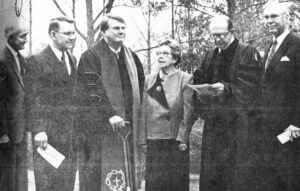
Pictured (from left) at the Hagan Chapel’s groundbreaking: Dr. Floyd Falany, Reinhardt president 1984-1999, Rev. Nat Long, pastor of St. James United Methodist Church, Dr. Robert Bridges, superintendent of the Atlanta-Marietta district of the United Methodist Church, Mrs. Blanche Hagan, chapel benefactor, Bishop Ernest Fitzgerald, leader of the United Methodist Church in Georgia, Dr. Reynolds Greene, incoming superintendent of the Atlanta-Marietta district of the United Methodist Church. (Reinhardt University Archives)
Well-known for his enthusiasm and oratory skills, former Reinhardt President Floyd Falany often traveled across Georgia spreading news about the great work of the College. Sometime in 1985, Dr. Falany received an invitation to speak at a Wednesday evening program at St. James United Methodist Church in Atlanta. Also, on the program that evening was the Reinhardt College Choir, directed by Judy MacMillan. Blanche Hagan was in the audience, and afterward Rev. Nat Long introduced her to Dr. Falany.
Ella Blanche Tippins Hagan (1902-1986) was an Atlanta resident and a smart, savvy businesswoman, who invested her resources well. Her husband was the late Harold T. Hagan (d. 1953). The Hagan’s owned the Pig’n Whistle restaurant in Atlanta (other locations could be found around the state), which opened in 1928. They also owned the Peacock Alley restaurant.
Blanche Hagan later visited the College. After Dr. Falany expressed a need for a chapel, she looked at her accountant who had accompanied her and she said, “Can I do that?” The response was, “Yes, of course. You can do anything you wish.” In that moment, she agreed to give $200,000. She ultimately gave $750,000 in total for the chapel.
The program for Hagan Chapel’s groundbreaking on March 9, 1986stated, “This dream is being made possible primarily through the generous support of Mrs. Harold T. (Blanche) Hagan of Atlanta. Many other individuals and organizations have also played an important role. Mrs. Hagan, a dedicated Methodist laywoman, made the naming gift in order to provide a structure which will have a positive and uplifting influence on the Reinhardt Community and will stand as a visible symbol of the College’s relationship to the United Methodist Church.”
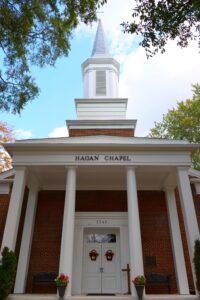
Hagan Chapel. (Reinhardt University)
In the program for the dedication of the Hagan Chapel on October 3, 1987, it stated, “After her death in 1986, Reinhardt College received from her estate the largest bequest in its history [at that time]. The bulk of these funds will be used for Methodist youth attending Reinhardt College.”
An article dated June 21, 1987, in the Cherokee Tribune announced the bequest, “The largest donation in the history of Reinhardt College, a $2.5 million gift from the estate of life-long Methodist Church supporter Blanche Hagan, will be used for scholarships and completion of the school chapel, say college officials.”
The Hagan Chapel continues to serve Reinhardt’s campus community and the local community. Reverend Brian Smith, pastor of WaleskaUnited Methodist Church, reflects, “I love how Hagan Chapel has become a cherished space for worship and reflection for both Reinhardt University and Waleska United Methodist Church. Its timeless design and sacred atmosphere stand as a testament to Mrs. Hagan’s generosity and her vision for a place of worship, peace, and community. Day in and day out, people experience the goodness of God’s grace in this special place.”
Reinhardt honors Norman W. Paschall in three ways:
- The Norman W. Paschall American Dream Scholarship Endowment.
- The Norman W. Paschall Plaza, located in front of the Martha S. and James R. Burgess, Jr. Administration Building.
- The Norman W. Paschall Office of Campus Ministries, located in the Hasty Student Life Center.
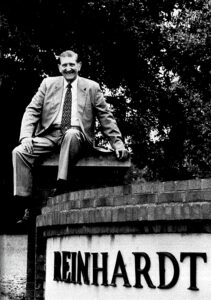
Norman W. Paschall. (Reinhardt University Archives)
Norman “Zeke” Winthrop Paschall (1919-2015) was born in Kingstree, S.C. and grew up in Greensboro, N.C. He was an excellent student and graduated from high school at the age of 16, but did not attend college due to The Great Depression. Instead, he began a career in the textile by-product business in 1935 working for the Railway Supply and Manufacturing Inc. in Charlotte, N.C.
Paschall was a WWII veteran in the Army Air Corps where he flew B-17 and B-29 aircraft and served as a flight instructor. In 1946, he established the Norman W. Paschall Co, Inc. in Atlanta, buying and selling cotton and textile by-products. He served on the U.S. Foreign Commercial Service Advisory Council and was the president of the Textile Fibers and By-Products Association and President of the National Cotton Batting Institute, where he was highly respected and known for his integrity, honesty, and leadership in the industry.
Norman Paschall was a member of the Board of Trustees from 1974-1999, serving as board chair for over a decade and emeritus trustee from 1999-2015. He also served as the chair of the development committee leading several fundraising campaigns for the University. Following his service as an active member, the board awarded him emeritus status. The University recognized him with two honorary degrees (Associate’s Degree in Humanities 1979 & Bachelor’s Degree in Humanities 1994) and the Volunteer of the Year Award in 1996, which was subsequently named after Paschall and awarded annually until 2003. He also received the John Wesley Laity Award for layperson leadership in the United Methodist Church. Paschall was very involved in his church, the Peachtree Road United Methodist Church in Atlanta.
In 1996, Paschall’s wife, Barbara “Bobbie,” established a scholarship in his name in honor of their 50th wedding anniversary and in honor of his service to Reinhardt. The scholarship supports students who show great promise, if given a chance, to pursue the American Dream. In a letter thanking Bobbie Paschall, dated March 5, 1996, then Reinhardt President Floyd Falany states, in part, “I share your hope that these students will choose to emulate the character traits of hard work, personal responsibility, and dedication to moral and ethical values at home and at work, as well as a genuine reverence for Almighty God so ably personified in the life of Norman W. Paschall.”
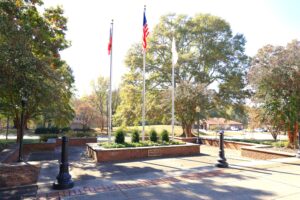
Norman W. Paschall Plaza. (Reinhardt University)
Dedicated on May 21, 1996, Norman W. Paschall Plaza honors his dedication to the United Methodist Church, his country, and his community, symbolized by the United Methodist, United States, and Georgia flags, respectively, in the Plaza.
The Office of Campus Ministries and an associated endowment is also named for Paschall. Established in 1996, the Norman W. Paschall Office of Campus Ministries consists of three areas: spiritual life, leadership development, and service. The aim of Campus Ministries is to provide students with options to develop their faith and volunteerism to enrich their spiritual life and community engagement while at Reinhardt and beyond.
The W. M. and Lucy Bratton Memorial Bell Tower is named for W.M. (Walter Marvin) Bratton (1878-1956) and Lucy Blackwood Bratton (1891-1963). W.M. Bratton served as 14th president of Reinhardt College from 1927 until 1944. Lucy B. Bratton headed the music department and directed the glee club.
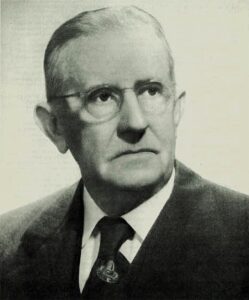
W.M. Bratton. (Reinhardt University Archives)
In the early 1990s, the classes of 1934-1938 collaborated on a fundraising campaign to honor the Brattons. Glenn (RU-1936) and Marjorie (RU-1937) Hubbard co-chaired a committee whose members wrote letters and called friends to raise money for the cause. More than $200,000 was raised to build the bell tower and establish the William M. Bratton Scholarship Endowment. The Bratton Bell Tower is a part of a memorial dedicated to Dr. and Mrs. Bratton, which was dedicated on August 15, 1985. The college bell that originally hung near Mary Stuart Whitam Administration Building 1912-1950 (now replaced by the Martha S. & James R. Burgess, Jr. Administration Building) and replicas of the columns given to the college by the class of 1934 along with the Bell Tower comprise the memorial.
The W. M. and Lucy Bratton Memorial Bell Tower was manufactured by the vanBergen Bell Company, an 18th-century Dutch bell foundry that began in 1795 in the Netherlands and later came to the U.S. (The company is a part of the Verdin Company of South Carolina). A similar bell tower was erected in honor of legendary country music singer, Patsy Cline, at her gravesite in the Shenandoah Memorial Park in Winchester, Virginia.
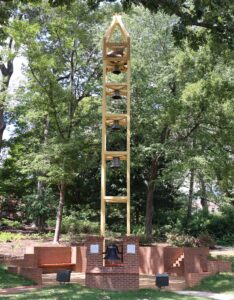
Bratton Memorial Bell Tower. (Reinhardt University)
Occasionally, the Bratton Memorial Bell Tower has been referred to as a carillon; it is not. A carillon is a pitched percussion instrument and has at least 23 bells. At Reinhardt, the Bratton Memorial Bell Tower rings daily to mark the hour, during the annual memorial service honoring community members who have passed away in the prior year, and for emergency notifications.
A native of Tennessee, W.M. Bratton earned a degree at Peabody College and did post-graduate work at Columbia University. Sources differ on his date of birth – various records say 1876, 1882, or 1884; however, his death certificate lists the 1878 date. His first name also causes confusion. All Reinhardt documentation during his presidency – catalogs, correspondence, newspapers – refer to him only as W.M. Bratton. In his 1969 book History of Reinhardt College, Bowling C. Yates refers to him as William Marvin Bratton. However, the 1898 Peabody College catalog, his marriage announcement, and his death certificate all name him as Walter Marvin Bratton. He was married to the former Lucy Blackwood and they had three daughters.
During Bratton’s seventeen-year tenure as Reinhardt’s president, the college took steps towards improvement and modernization. New physical facilities built during these years included a gymnasium, two dormitories – Cherokee Hall and Paul W. Jones Hall, new barns, and a canning plant. Georgia Power extended electricity to Waleska and the campus in 1929 and a new water system was installed in 1936. In 1942, the highway from Canton was paved to the Waleska city limits. Also, the state of Georgia recognized Reinhardt as a junior college and was approved as a teacher training institution.
Chester Thurman Tarpley (1892-1984) was a local farmer and a carpenter. In 1914, he married Louise L. Ledford (1891-1955). They had four children: Carl, Fred, Merle, and Cora Belle. Chester helped build some of the buildings on Reinhardt’s campus, and by doing so earned a Reinhardt education for his children. Eight members of Chester’s and Louise’s direct descendants attended Reinhardt. All went on to touch countless lives as nurses, teachers, and in other giving professions.
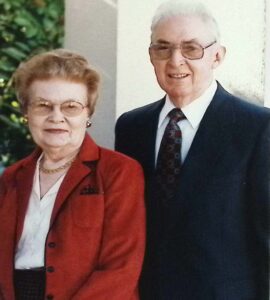
Mozelle and Fred H. Tarpley. (Reinhardt University Archives)
Chester and Louise Tarpley’s son Fred and his wife, Mozelle Bates Tarpley, both graduated from Reinhardt in 1940. Fred and Mozelle moved to Dalton in 1946 and were long-time members of the First United Methodist Church. Fred Harold Tarpley (1921-2003) worked for 40 years in the banking industry. Mozelle Tarpley (1921-2013) was a teacher for many years in Murray County and Dalton Public Schools. Both cherished their time at Reinhardt and knew the importance of education.
Fred and Mozelle Tarpley’s significant generosity provided many wonderful opportunities for Reinhardt’s students and faculty over the years. In their honor, two spaces have been named. The Fred H. and Mozelle Bates Tarpley Education Center, dedicated on May 22, 2001, houses faculty offices, study spaces, and numerous classrooms. A breezeway that serves as a lounge for students and faculty alike connects the Tarpley Education Center to the George M. Lawson Academic Center. When Mozelle passed away, she left a significant bequest to Reinhardt. The University named the University Theatre’s vestibule in her honor in 2018.
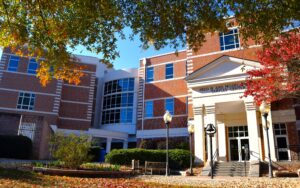
Fred H. and Mozelle Bates Tarpley Education Center. (Reinhardt University)
Fred’s sister, Cora Belle Tarpley Holcombe (RU-1951, 1929-2000), is also honored on Reinhardt’s campus. In 2023, a bell was donated by Reinhardt University nurse Gwen Chambers (RU-1984) and her sisters, Dr. Sharon Pappas and Gina Mitchell (RU-1978), in honor of their mother, and Fred’s sister. As a local educator, Cora Belle Tarpley Holcombe served Ball Ground, Clayton, and R.M. Moore Elementary Schools for over three decades. According to Chambers, “She modeled Reinhardt’s mission to ‘educate the whole person with challenge and care.’”
The bell represents the members of the Tarpley family who have dedicated their lives to improving the well-being of children and their families. Located at the entrance of the Tarpley Education Center, the bell rang for the first time at a dedication ceremony on November 10, 2023. Students ring the bell at the beginning and end of their educational journey at Reinhardt.
